Wednesday, February 25, 2009

Josephine Baker: Singer, Dancer, Spy, Hero


If you read my memoir Kinky Gazpacho, you know Josephine Baker was my childhood idol. I ran away to Spain, because Josephine ran to France. She hailed from the Midwest (St. Louis) as did I (Milwaukee). She was a talented singer and dancer, and I never met a microphone I didn't love. As far as I was concerned, by age 12 I knew my life would be lived in the footsteps of La Baker, minus the whole banana skirt incident.

For me, Josephine Baker represented everything a Black woman could do when unfettered by the constraints of a racist society. She lived her life fighting against expectations. I know she was far from perfect -- because really who is -- but it seemed that everything she did was a protest against the system. Her family of adopted children from every nation. Her expat existence in Europe. And her work as a spy for the French resistance. In my mind, Josephine Baker was James Bond, Wonder Woman, Mary Poppins and Diana Ross all rolled up into one. And I wanted to be just like her.

So, I just found out that the International Spy Museum in Washington, DC is hosting a special lecture: Josephine Baker: Singer Dancer, Spy on Wednesday March 6. The description of the program states:

From Broadway to the Rue Fontaine, the extraordinary Josephine Baker
was the toast of the international nightclub circuit. Born in the United States, the talented African American singer-dancer moved to France to escape racism in America and became an enormous star. She triumphed at the Folies Bergère and enjoyed the acclaim of European society. Her affection for France was so great that when World War II broke out, she volunteered to spy for her adopted country. Her café society fame enabled her to rub shoulders with those in the know, from high-ranking Japanese officials to Italian bureaucrats, and report back what she heard. She heroically stayed in France after the invasion working closely with the French Resistance to undermine the Nazi occupation. Her espionage exploits are just one chapter in Baker’s extraordinary life.
Join Jonna Mendez, former CIA chief of disguise, as she reveals
Baker’s intelligence work and places it in the context of her exciting and celebrated life.


If I lived in DC, I'd be there in a hot second. Those of you who do live there, somebody please go and tell me all about it.

Peace!

(Hat tip to Harvetta at Presse Books for the info.)

Monday, February 23, 2009

Do You Expect More From Your Own Kind?


Somebody gave me a gift certificate to a certain giant bookstore for my birthday. So, on my birthday, I headed to said bookstore giddy with excitement. To have free money to spend on books, you couldn't make me any happier.

I ended up buying three books. A cookbook, a bargain, "How to Play Your Guitar" book (I still dream of being a street musician, but that's a story for another day.), and a novel by an author I'd never heard of, a Black British woman named, Dorothy Koomson.

The novel is called, Marshmallows for Breakfast and judging from the cutesy, pastel-heavy cover, I knew I was buying chick-lit, but it was the image on the cover that hooked me. The cover shows the backside of a woman and child holding hands. The woman is Black and the child is White. Goodie, I thought. Chick-lit with a multiracial cast. Something new. Characters that looked like me. A story-line with a twist! The cover also noted that Ms. Koomson is an "international best-selling author," so I thought that guaranteed a bit of quality. Boy was I wrong!

I don't want to make an enemy of Ms. Koomson. I might meet her one day. And she's probably a lovely human being, but this book was so bad I wanted to put it under the wheels of my car and roll over it several times. I'm not even going to waste this cyberpage to write why I thought it was so bad. But here's why I'm so annoyed. I REALLY WANTED TO LIKE IT. I gave it my all and read the whole damn book. I put my faith in Ms. Koomson that somehow the convoluted story line would eventually make sense. Why? Because she's Black. Is that wrong? Of course it is, but here's why I did it. I figure with the way the publishing industry pigeon holes Black authors, if you are a Black author and have managed to achieve international bestseller status -- especially in a category like mainstream chick-lit -- you must be really good. Plus, she's Black (I said that already, didn't I?) Don't you just expect more from your own kind? I just knew the book would touch on issues that matter to me: that Ms. Koomson would explore the subtle nuances between Black and White in romance and modern-day relationships. She'd slyly refer to hair issues and ashy skin. But no. And don't get me wrong, that's not why I give the book two big thumbs down. The omission of those details just made it worse.

Why do we expect more from our own kind? Do you do that? In what context? Are you constantly disappointed or have you learned to temper your expectations? Feel free to chime in.

And just because I know my opinion means nothing in the big scheme of things, please feel free to check out Ms. Koomson's website to read more about her and her books. And just to show that I can't really give up on her-- I still want to believe-- I may try to read another one of her books. Maybe Marshmallows for Breakfast just wasn't her best effort. Anybody out there a Dorothy Koomson fan? Please tell me why you love her.

Peace!

Friday, February 20, 2009

And Speaking of Asian Men...


I love movies, but I must admit that I don't have cable (waste of money and brain waves). I don't subscribe to Netflix (Tried it, wasn't for me). And because I don't earn enough money to head to the cineplex every weekend, I generally use my local library as my own private video store. Well, not really private, but you understand what I mean, right?

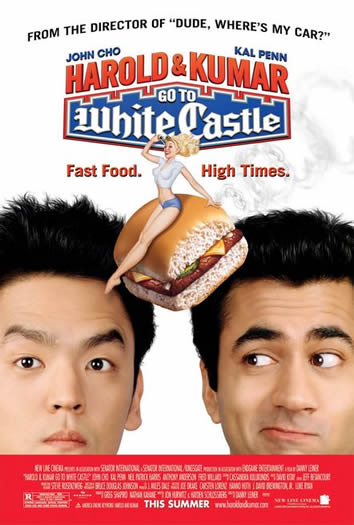
Sometimes the pickings are slim, but most times I can find recent hits, classic oldies or that one film I never got around to seeing but really wanted to, or that one film I was really curious about but would have never paid money to actually see in a theater. Like, Harold & Kumar Go to White Castle(2004), starring Kal Penn and John Cho. Because I thought the movie was basically targeted to young boys into dumb stoner movies, it was never on the top of my list of 'must-sees.' But the Meltingpot in me was always intrigued by a movie that has developed a cult-following with two Asian leading men (Oh, and a scandalous cameo by Neal Patrick Harris!). So, of course when I recently stumbled on a copy of the film at the library, I scooped it right up. And you know what, I laughed my ass off throughout the whole thing. I made el esposo watch it with me and he laughed too.

But here's why I liked it even more. Even though the movie clearly falls in the dumb stoner/male-bonding/full of fart jokes comedy genre, screenwriters, Jon Hurwitz and Hayden Schlossberg, do a pretty good job incorporating some very real racial/cultural issues by both poking fun and making both subtle and overt issues of racism central to the storyline. I give the whole cast and crew an A+ for making a film with a multiracial cast of characters that spares no one from derision and yet ultimately allows two Asian guys to be the heroes of their own destiny (for one night at least.). Don't get me wrong, this is not a Meltingpot family movie, and I don't even know if I'd allow any kids under 16 to watch it. But two grown adults looking to laugh, on a Wednesday night (That's when I watched it, while folding laundry.), I say go for it!

I'm just curious if anyone else out there has seen this film? What were your thoughts? I'm curious if anyone, particularly Asian anyones, were offended by the film? Why? Please share. And what else can I see John Cho in besides the sequel to this movie?

Enjoy the Weekend!

Peace!

Wednesday, February 18, 2009

Do You Know This Man? (Not Obama, the Other Guy)


Remember the tag line of the Meltingpot is "keeping track of where cultures collide, co-mingle and cozy up?" Well, I just had to bring your attention to some more cultures cozying up in the Obama administration. Do you all know the story of Eugene Kang? He's a 24-year old Korean-American political wunderkid, who also happens to be special assistant to President Obama. Did I mention he's only 24!

I love Kang's story because it is America's meltingpot working at its very best. The American-born child of Korean immigrants, Kang grew up in Ann Arbor, Michigan. Got a taste for politics early, ran for city council while still in college and got involved in the Obama campaign before Obama was, well, OBAMA. Even better, Kang was very instrumental in helping many Asian-Americans transfer their support away from Hilary Clinton, in the primaries, and vote for Obama. How did he do this? By pointing out Obama's many ties to the Asian community, including growing up in Hawaii, living in Indonesia, and having an Asian stepfather and sister, just for starters.

Not that I believe in multiracial fairy tales, but as a big fan of the exquisite combination of Kimchee and chitllin's, I hope the Obama/Kang connection plays its role in promoting the positive in Black/Korean relations. We definitely need more love there. And if anybody can do it, my vote would be for Obama... and Eugene Kang. Yes, they can.

Peace!

Friday, February 13, 2009

The Meltingpot Book Reivew-- The Help


"Mae Mobley was born on a early Sunday morning in August, 1960. A church baby we like to call it. Taking care a white babies, that's what I do, along with all the cooking and the cleaning. I done raised seventeen kids in my lifetime."

And so begins first-time novelist, Kathryn Stockett's wonderful new book, The Help (Amy Einhorn Books).

I have to admit, knowing Stockett is White (her picture is on the back of the book) made me a wee bit skeptical as the opening chapter is written in the first person of a Black southern maid in "vernacular." There was this guarded skepticism on my part that a White woman could truly get in the head of a Black domestic. But not 10 pages into this well-told story and I'd completely forgotten about Stockett and was completely mesmerized by the inter-connected stories of Skeeter, Aibileen, and Minny, the main characters in this heart-warming book. Aibileen and Minny are Black maids in 1962 Jackson, Mississippi and Skeeter is a White, recent college graduate who returns home to Jackson yearning for her real life to start.

The three women end up on a "secret project" together to do their part to help bring about some sort of change in their racially charged city where Civil Rights activists are being brutally murdered and White people who sympathize with Blacks get their homes fire bombed. But make no mistake, this is not a book about police brutality and KKK raids. Instead Stockett takes us into the daily lives -- bridge club, Junior League meetings, church -- of everyday people, both Black and White, to show us what racism really looks like and feels like, up close and personal. How it feels in your home and at the grocery store and late at night after you put your children to bed. This is most definitely a woman's story where men are relegated to supporting roles. The bad guys are women and the good guys are too.

Even though this is a work of fiction, the story feels quite authentic and includes some real historical figures and events. It gives readers a better understanding of the complicated relations between Blacks and Whites in the South without being preachy or didactic. I think I loved the book even more after I read Stockett's afterword where she writes:

"I was scared, a lot of the time, that I was crossing a terrible line, writing in the voice of a black person. I was afraid I would fail to describe a relationship that was so intensely influential in my life, so loving, so grossly stereotyped in American history and literature."

I can't help compare this book to Sue Monk Kidd's, The Secret Life of Bees. Another tale that explains how southern Blacks and Whites could live and love one another despite the virulent racism pulsating all around. But like Bees, there's no sugar coating in The Help. Stockett does a masterful job of explaining how that thin line between love and hate can be crossed every day, back and forth, until the line blurs into something far more complicated.

I hope this book receives lots of attention and many different people pick it up to read. Not only will it make an excellent book club read, but it will hopefully continue our most important conversations on race.

Thank you Kathryn Stockett for deciding this story --a story about The Help -- was important enough to tell and for conquering your fear and telling the story anyway.

Peace!

p.s. This book was reviewed as part of a Mother Talk Blog Tour.

Wednesday, February 11, 2009

Food for Thought--Discovering the Pupusa


Recently I was in the Washington DC area visiting with friends whose children suffer from a laundry list of allergies. Combined with my own new sugar-free, wheat-free diet plan, deciding on where to eat for dinner posed a bit of a problem. But not for long. My friend, already well-versed in the nearby take-out restaurants where both of her kids could eat without going into anaphylactic shock, suggested Peruvian food. Not knowing a thing about Peurvian food except that corn plays a prominent role, I happily agreed and allowed her to do the ordering.

When she came back with bags of these bean and cheese stuffed corn pancake things called pupusas, I thought I had died and gone to heaven. The pupusa according to Wikipedia actually has its origins in El Salvador, but plays a prominent if not slightly modified role in the cuisines of several Latin American countries. The pupusa is actually just a thick corn tortilla but it's what you stuff it with (pork, beans, cheese, veggies), slather on it, or roll in it (sirloin, lettuce, onions, and cilantro) that makes it so wonderful. The closest thing I can compare it to is an arepa. I don't know how I made it through life up until now never having experienced a pupusa. Am I the only one? Has everyone else out there been noshing on pupusas (Don't you just love saying the word, even? Go ahead say it aloud and tell me it didn't make you giggle.) and just didn't tell me? I will now be going on a mission to find a pupuseria in Philly to feed my cravings. I hope you can find one too.

Peace!

Monday, February 09, 2009

A Sweet New Book About American Slavery

Okay, even though I just slammed the whole concept of Black History Month, I'm so excited about this new book that just came out, just in time for BHM.

The book is called Sugar of the Crop: My Journey to Find the Children of Slaves by Sana Butler. As the subtitle would suggest, the book details the author's ten-year journey to find the last living children of slaves, interview them and tell their story. I admit I'm only on page 12, but I'm loving the book already. It almost reads like a historical memoir because Butler doesn't remove herself from the story. In fact, she plays a central role explaining how people laughed at her when she admitted she was looking for living children of slaves, how this epic journey swallowed up a decade of her life with serious repercussions professionally and personally, and how watching her own father slowly dying as she made this quest, fueled her passion to complete the book.

What I like about this book, from a BHM perspective, is that it allows Black people to speak for themselves about the role they played in American history. What's more, by hearing first-hand accounts from people who survived and even thrived despite the cruelty of human bondage shows a far more nuanced and truthful depiction of the "Black experience." Not to say that slavery had its good parts, but Butler admits she's going on this journey to discover, "how slaves became husbands and wives; mothers and fathers and how they raised their children." And we need to hear those stories. We all need to hear those stories. So I'm going to keep reading, thanking Butler for this amazing book she has created.

To hear Butler talk about her experience writing the book on North Carolina public radio, click here.

Peace!


P.S. Our Opinion Poll Giveaway Winner is Nikeshia. Congrats! Send us an email to myamericanmeltingpot@gmail.com with a mailing address and you'll receive your copy of asha bandele's Something Like Beautiful. Thanks to everyone who responded. And I hope both Madonna and Angelina Jolie read The Meltingpot so they know how much support they have!

Friday, February 06, 2009

My Love/Hate Relationship with BHM


I'm a big hypocrite when it comes to Black History Month. My capital-B, Black revolutionary self believes the very concept is offensive, for so many reasons. Mainly, because Black history shouldn't be segregated from the rest of American history. By doing so, it gives people a free pass to ignore the role Black people have played in shaping this country since setting foot on American soil. Black history, Hispanic history, it's all American history. What the heck is America except a country made up of a whole lot of foreigners anyway? Why should our contributions be singled out in February and not included in every other history book, text and educational curriculum? Why don't we talk about Bessie Coleman along side Amelia Earhart? Why isn't Zora Neale Hurston as important as Truman Capote?

But then there's me the author and speaker who happens to be Black and who happens to have a lot to say about Black people and their contributions to American culture. And guess what? My phone rings more in the month of February than ever before. Everybody wants a piece of me during February and I have a mortgage to pay and two very hungry boys to feed. So professionally, BHM is like my cash cow and boy do I know how to milk her. Of course I try to use my BHM speaking and writing engagements for good. I spread my message of multicultural history and hope to make people stop and think. Maybe get the rest of the country on board for integrating all of the colored people's history into the big book and celebrate all year long. But then of course, I'd have to find another cash cow.

So what do you think about Black History Month? Does it serve a purpose or does it do more harm than good? What do you do to celebrate or protest? Please share.

And don't forget to comment on our first opinion poll and get a chance to win a copy of asha bandele's, Something Like Beautiful.

And one more thing. If you're interested, Nadya Suleman, the mother of octuplets is spilling her story to NBC's Ann Curry. The link shows a clip from the interview but the full interview will air on Monday on the Today show.

Enjoy the weekend!

Wednesday, February 04, 2009

And Speaking of Single Mothers...


I realize that my last few posts have all in some way highlighted the single mother experience. So I'm going to keep going with that theme and talk about a newly single mother who is also in the media a lot, my girl, Madonna.

For all accounts and purposes, Madonna is a White woman, and yet she is parenting a Latina, British and African child. We give Angelina all the rainbow coalition credit, but when you think about it, Madonna is doing her part too to expand the definition of the multicultural/international/transracial family.

So, my Meltingpot readers, here's our first Meltingpot opinion poll. Who do you think is going to do a better job at instilling in their children a sense of ethnic pride and identity, Angelina Jolie or Madonna? Why do you think that way?

Everyone who answers will be entered in the second Meltingpot Giveaway. I'm gifting a copy of asha bandele's new book (in hardcover) about being a single mother, Something Like Beautiful. Get your answers in by Friday at 6pm. The lucky winner will be announced on Monday, February 9.

Peace!

Monday, February 02, 2009

Will Race Matter in the Multiple Baby-Making Mama Drama?

"Please God, don't let her be Black," is what I read on Facebook and echoed on the subways and street corners. It seems everyone is talking about the 33-year-old woman who recently gave birth to octuplets in southern California. People are talking because not only did she give birth to eight babies at once, she already has six kids at home, no husband, no job and she still lives with her parents. Oh, and she used assisted reproductive technology with all of her pregnancies.

But no, Nadya Suleman is not Black. Even I have to admit I sighed in relief when I realized Ms. Suleman wasn't one of "my kind of people," because Black people just seem to always get slammed worse when it comes to un-wed, baby-mama drama and this is like baby-mama drama times 14! But we're not in the clear.

I have no idea what racial/ and or ethnic heritage Ms. Suleman claims, but it is clear by her surname, and the physical appearance of her parents (who have been seen in press photos) that she is not Caucasian. And as such, I'm guessing that whatever she says about her choices to parent, they will be viewed through the prism of race and ethnicity in a negative way. Does anyone disagree? Will Ms. Suleman be receiving offers for her own reality TV show and free trips to Disneyland, or hate mail from "real Americans" who view her as the reason this country is in crisis right now?

I, for one, will be keeping track of where this story goes and how it is reported. I don't envy Nadya Suleman one bit right now. But I wish her all the luck, time and energy she will need to raise 14 children all alone.

Peace!