Friday, July 31, 2009

The Meltingpot Book Review -- Run by Ann Patchett


Here's a book that I might have never picked up if a good friend hadn't suggested it. In fact, even after reading the flap copy I really didn't want to read it at all as it sounded like a book about an old White politician in Boston and his attempts at keeping his family together no matter what the cost. Not exactly the Meltingpot's cup of tea. And even the cover left me limp, with its sterile white writing and nebulous blue background.

But boy was I wrong. About everything. Even the cover. In Run, Ann Patchett, the award-winning author of Bel Canto, has crafted a marvelous novel about an interracial family formed through adoption that is neither about race nor adoption but still gets at the nuances of these very complicated subjects.

The main characters, Tip and Teddy, are African-American brothers adopted as infants by a traditional, well-to-do Irish Catholic family in Boston. The story really begins when the boys are college students, chafing against their father's dreams for them to enter the political arena. Tip wants to be a scientist and Teddy feels called to the priesthood. When a horrible accident happens, everyone has to rethink their own desires.

Patchett is not Black and she hasn't broken any new ground in terms of getting inside the head of an African-American male, but she has crafted an honest and believable story with characters who will seem familiar yet wholly unique. Stereotypes play no part in this book. What's more, Patchett weaves a touch of Irish folklore and a whisper of the supernatural to make the book that much more compelling and will have readers flipping through the pages to find out what happens to this special family.

My only Meltingpot commentary is about the packaging of the book. I wonder how many more people would pick the book up if the cover and/or the flap copy gave some indication as to the multi-cultural nature of the story, i.e. there are Black people involved. Or maybe that was the point. Obscure cover, bland flap copy, best-selling author, her fans will pick it up and that's all we have to worry about.

Why publishing industry? Why? (sigh)

Anyway, despite the whitewashed packaging, I still give it two very big thumbs up and recommend it to anyone who enjoys a well-written, contemporary drama that touches on issues of race, class, politics and a hint of mysticism.

Has anyone else read this book or anything else by Ann Patchett? Does she always incorporate race into her novels? What do you think about her work? What other books of hers did you enjoy? Please share.

Peace!

Wednesday, July 29, 2009

It's Not What You Say, It's How You Say It...(In English or Spanish)

When I met el esposo, I was living in Spain, trying to perfect my Spanish. I was taking classes at the famed Universidad de Salamanca, situated in a region of Spain known for its absolutely perfect Castillian Spanish. When my Spanish classmates found out I had befriended this guy from the South of Spain they warned me that he would be a bad influence. "Why?" I wondered. And they all responded that they don't speak properly in the south of Spain. They made it sound like southern Spaniards weren't very educated and had a horrible grasp of proper Spanish.

Obviously I didn't pay attention to the warnings because I married my Southern Spanish friend and have allowed him to help me with my Spanish for the last 15 years, but it is an interesting situation. El esposo always bristles when people from the north of Spain (and elsewhere outside of Spain as well) imply that southern Spaniards don't know how to speak proper Spanish. He claims that grammatically, they speak correctly but their accents, and the way they pronounce certain words and the speed at which they talk (really fast) makes them targets for the rest of Spain to mock. Kind of like southerners in the United States.

I mean who doesn't hear a Southern accent and almost automatically some stereotype jumps to mind. Either of Scarlett O' Hara, or the KKK, or at the very least, someone who sits on a porch and sips sweet tea from time to time. Of course these are stereotypes, but I would feel safe to say that many people with strong southern accents in the United States, if they go North for a job or schooling, may feel the need to tone it down in order to be taken seriously. My husband says it is the same here in Spain.

When el esposo went North to go to college, he claims that for the first month the other guys in his dorm, as well as his teachers, just kind of stared at him with confused looks on their faces whenever he opened his mouth. They couldn't understand a word he said. So very quickly he learned to drop his accent and spoke more slowly and got rid of some of the southern slang he'd used all of his life. And he was fine. And of course whenever he comes home he slides right back into his comfortable southern speech. I have asked that when he speaks with our children that he speaks a kind of neutral Spanish as well so they don't have to learn to code switch as they pass in and out of different Spanish speaking situations. And he's okay with that. He loves his language, his southern Spanish language, but he understands the reality our children are living in as well.

So, I'm wondering...The rest of you, do you code switch with your language? Do you speak one way at home and another in public? Is it based on region, culture, comfort? Let's hear it. I'm listening.

Peace!

Monday, July 27, 2009

Down South


Last night I shared my bedroom with a lizard (actually it was a salamander, el esposo assured me, as if that made it any better). Yesterday afternoon in 100 degree weather, I hung my clean clothes out on the line, knowing the blazing hot sun would have them dry in minutes. And right around dusk yesterday evening, my brother-in-law brought over three ripe watermelons picked fresh from his wife's family garden. Without a doubt, I'm down south.

Funny that I'm in Spain and yet the cultural norms of being down South mimic my own summers spent with my grandparents in Maryland. (Some wouldn't call Baltimore south, but I do, especially when your grandparents are transplants from North Carolina.) Summers with my grandmother meant tagging along while she hung all of our clean laundry on the line in her backyard, then collecting the fresh vegetables she had growing in her garden. Every day my great-grandfather, Papa Carter, stopped by to drop off a huge watermelon and a pack of chewing gum for his favorite granddaughters. And heaven was baking lemon cakes with my grandmother and then decorating them with wild raspberries plucked straight from the vine. For the rest of the day my older sister and I mostly entertained ourselves, playing jacks on the porch and collecting lightning bugs in grape jelly jars at night.

My parents on the other hand, though originally from Mississippi and North Carolina, now live in a two-bedroom condo in Milwaukee, Wisconsin. There is no sending my kids south to visit. Or so I thought until now. Being here in the south of Spain this summer with my boys at an age where they notice differences and can participate fully in daily life, I am thrilled to see them taking part in a way of life that I associated only with my southern Black roots. But clearly the Black is inconsequential in a way.

My sons are learning here how good food tastes when it comes right from the farmers' stall at the market and they are learning to appreciate a nice rest after a good meal. (Unlike home where I'm met with only moans and groans if the words 'nap' or 'rest time' should escape from my lips.) They now know that clothes pins are actually for hanging up clothes and not just for art projects at school. My older son, who takes after his mother when it comes to creepy, crawly things (meaning he shrieks like a girl whenever a bug comes near him) was thrilled to tell me he found a dead lizard this morning in the back garden! And maybe most importantly, both of my sons are learning how to just slow down. I love it.

At the end of the day, this southern Spanish experience doesn't really surprise me. It serves only to remind me that when I picked el esposo to be my partner, even though on the outside we seemed to come from different worlds, I could tell he was a kindred spirit. I could tell our life views were shaped by similar forces, mainly a strong bond to family, where both families come from down south.
***************************

Coming up next, the connections between a southern Spanish lisp and an American southern drawl.

Peace!

Thursday, July 23, 2009

MaƱana, Siesta, No pasa nada...I´m in Spain

Hola Meltingpot Readers,

I´ve been in Spain for only three days and already I´ve fallen prey to the southern Spanish lifestyle. I eat, sleep, swim, read and repeat. I cannot for the life of me summon the energy to do much more than that. My children are in heaven because I say things like, "If you´re not too tired, after dinner (at 10pm) you can watch TV a little bit before bed." Who have I become?

It´s funny, I used to resist this descent into sheer laziness everytime I came to the south of Spain, but now I try to embrace it as I very rarely have the freedom to do so at any other time of my life. What´s more, ten days after I return to the United States, I begin my first full time job after seven years of freelancing. I will be teaching at Temple University in the journalism department with a real title of assistant professor, instead of adjunct. Cool, right? But with that title, comes pressure, and deadlines and homework and everything else I don´t have to deal with in this little piece of paradise. So...I´m giving myself permission to slack off. To read the five fantastic books I brought along with me during the day instead of in snatches before bed and in the bathroom. I am going to be satisfied if the most strenuous thing I do is take a long walk on the beach with my children. And I will not allow myself to feel guilty about it. This is a blessing and I am working on feeling gratitude.

The only "work" I must do is finish the final revisions on my novel. And given my current circumstances, where I am at peace and have so much time on my hands, working on my novel doesn´t feel like work. It is pure pleasure.

So, dear readers, thanks for checking in, and please continue to do so as I keep you posted on just how lazy I can be and what´s going on in my little world.

Peace!

Friday, July 17, 2009

My Kinky Gazpacho Life Can be Yours for a Price


Hi Meltingpot readers,

As I mentioned in an earlier post, I'll be off to the Iberian peninsula in just a couple of days and I will be posting from Spain for the next few weeks. Look for my first post on Tuesday July 21. I'll try to bring you all of the Meltingpot news from the South of Spain and of course anything interesting with our little Kinky Gazpacho family. You know we always cause a stir when we go down there.

And in the meantime, for those of you who may want to plan your own little excursion to the South of Spain, perhaps inspired by all of my tales told here, not only can you visit some of the places I write about in my book, Kinky Gazpacho, you can stay in the former home of my in-laws. The house where I first met el esposo's family. Have they opened their home to American tourists, you wonder? No. They sold their home and it is now a hotel!

Yes, dear readers, some of my most treasured and intimate memories can now be experienced by you, the rest of the world, at Hotel Nuro in Barbate, Cadiz. Talk about the surreal life. It's more of a super nice hostel than hotel, but they do promise air condition and a TV in every room, so you can't go wrong. I met the couple that owns the hotel and they seem very nice.

Besides reliving my life, the only other reason one might go to Barbate is to study washed-up fishing towns, or to go to the beach, so I highly doubt the Hotel Nuro is going to be on your must-see lists, but if you do manage to go, tell the owners that La Americana Morena says "Hola" and you may get a discount.

Hasta Pronto.

(p.s. The picture is a street shot of the Hotel Nuro. And the door to the left is where el esposo's aunt still lives.)

Wednesday, July 15, 2009

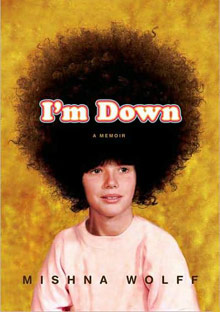
The Meltingpot Book Review -- I'm Down by Mishna Wolff


From the jacket copy: "Mishna Wolff grew up in a poor Black neighborhood with her single father...Unfortunately, Mishna didn't quite fit in with the neighborhood kids: she couldn't dance, she couldn't sing, she couldn't double Dutch, and she was the worst player on her all-Black basketball team. She was shy and uncool... And yet when she was suddenly sent to a rich White school, she found she was too 'Black' to fit in..."

Doesn't this premise sound like a familiar story of many popular memoirs of Black kids growing up and feeling alienated in their Black surroundings because of their quest for an education and their just plain "un-coolness?" Starting with Black Ice, Project Girl, White Bucks and Black Eyed Peas, I could rattle off a dozen of such stories, so what makes Mishna Wolf's I'm Down different? Wolff isn't Black. She's a pure bred White girl.

"I am White. My parents, both white. My sister had the same mother and father as me --all of us completely white. White Americans of European ancestry. White, white, white, white, white..."

And so begins Wolff's hysterical yet poignant memoir of growing up with a White father who truly seemed to want to not just BE Black, but wanted himself and his daughters to be accepted as authentic in their urban, Black neighborhood in Seattle.

I admit I wasn't sure what to expect from this book. I feared Wolff might just resort to relating "funny" anecdotes of her father and herself trying on gross stereotypes of Black behavior. But she doesn't. Instead she describes a very peculiar childhood, one that is often sad and dysfunctional, that strangely enough seems to hinge on a father who probably should have been seeking professional help for his delusional and sometimes dangerous behavior. That being the case, Wolff clearly has a talent for seeing the absurd in her past and tells her story with a comic's talent. Even while I was feeling sorry for the little girl who ached to fit in, I was laughing my ass off at the same time.

I'm Down is a great summer read. I read it one day (Granted, I was recovering from wisdom teeth surgery and had an excuse to stay in bed all day). You'll really enjoy the story and you'll come away with yet another example of why this thing we call race, these definitions of Black and White, are only skin deep.

I look forward to more work from Mishna Wolff.

Peace!

Monday, July 13, 2009

Death be Not Proud...and Other Stuff


Hello Meltingpot Readers,

Thank you so much for your kind thoughts and patience. I really do appreciate it. I was kind of surprised myself as to how much the death of my uncle unraveled me. My uncle was the one boy in a family of 10 girls and was legendary in the family. With all of those sisters he kind of had to be.

Going home for the funeral included a healthy helping of drama. Big surprise, right? Why is it people have to act a fool when a loved one dies? In our family the drama erupted over the type of funeral my uncle would have. Coincidentally, my uncle's wife of 17 years is White and she belongs to a church that is "different" than the majority of the rest of my Black family. And that just didn't sit well with some of my aunties. At the end of the day, everything was worked out, with a few ruffled feathers and some "no she didn'ts." From my perspective, the biggest difference between the "White" funeral my uncle's wife planned, and the typical ones I've attended in Black churches, was the absence of weeping and wailing and a whole lot of carrying on over the dearly departed's dead body.

Now don't get me wrong. I'm a big fan of weeping and wailing at funerals. I feel like it serves a purpose. In fact, one of the reasons I feel like I had to grieve some more at home is because I feel like I didn't have a chance to get the bulk of my sadness out during the funeral. Does that sound crazy? I actually missed the shared expression of crying our eyes out together. Even though it's horrifically painful to see your mother and other elders who you look up to for guidance, wracked by grief, there's something about going through it together. What about you dear readers? How do the people in your family and/or culture deal with death? What are your rituals and do they help you process your grief? I'd like to hear your stories. Thank you.

Peace!

********************************

And P.S.

If anyone is going to be in New York City tomorrow, July 14, I will be at the NACCP Author Pavilion as part of the 100th Annual Convention. The Author Pavilion is at the Hilton Hotel at 1335 Avenue of the Americas, New York, New York, United States 10019

I will be there all day, but signing from 12-2pm. There are going to be some great authors there, and the entire Author Pavilion is free and open to the public today, tomorrow and Wednesday (July 13-15). Yeah Colored People!

********************************

And P.P.S.

The Meltingpot is heading to Spain next week and will be posting from her in-laws lovely seaside home for an entire month. Any questions you want to ask about Spain, things you'd like for me to investigate, post them here and I'll try to look into it.

Monday, July 06, 2009

Obstacles in My Way

Hi Meltingpot Readers,

First the internet died and then a dear family member. I'm away on grief leave but will return soon.

Please keep checking in.

Thank you for your patience.

Peace!