Hi Meltingpot Readers,
I'm still grading papers, but I couldn't let this one slip by. And by this one, I mean Alice Randall's cringe worthy op-ed piece that ran in last Sunday's New York Times where she declared that "many Black women are fat because we want to be." Ouch. That wasn't the point of the article, but it's the message that people are sure to walk away with.
I don't have time to write out why I think Randall was wrong on this one, but that's okay because many others have done the work for me. Over at Madam Noire, there is a well-worded response that sums up my feelings exactly. For the record, I am a big fan of Randall's fiction, but I don't know what she was thinking when she sat down to write this piece. (sigh)
I'm listening if you want to share.
Peace.
Showing posts with label Black Beauty. Show all posts
Showing posts with label Black Beauty. Show all posts
Wednesday, May 09, 2012


Monday, April 30, 2012
Black Beauty Queens Causing Controversy in France

Bonjour Meltingpot Readers,
I was intrigued by the latest racial brouhaha coming out of the city of lights. And, no, I'm not talking about presidential hopeful Francois Hollande using Jay-Z and Kanye West's song in one of his campaign videos. I'm talking about the recent controversy over the first ever Miss Black France competition.
This past Saturday, the lovely Miss Mbathio Beye was crowned the first Miss Black France, despite protesters and critics who cried foul. Depending on who you ask among the dissenters, the idea of a Miss Black France was either a racist competition that excluded Whites or a misguided feel good opportunity that sent the wrong message to a country dealing with a rise in anti-immigrant sentiment. But according to the Miss Black France organizer, the purpose of the competition was to "celebrate black beauty," and to "shine a light on the many Black women in [France] who are rarely given any media attention."
As an American who is used to seeing everything -- from beauty pageants to greeting cards -- segregated and celebrated along racial lines, I initially didn't see anything wrong with a Miss Black France competition. In fact, I saw it as progress, or at the very least an opportunity for Black women to have their beauty acknowledged in a country that's been a little lax in that department. And for the most part, I still feel that way. But knowing that most European countries pride themselves on not being racist simply because they don't acknowledge racial differences, I can see how this Black beauty competition might feel like a step in the wrong direction.
But, you can't have your chocolate cake and eat it too. The French want to say everyone is equal and that they don't distinguish White from Black, and that French is French, but we all know that simply isn't true. (And obviously, this is not just a French problem.) Without going into all of the racial politics in France, we know that people of color still struggle for equal rights and opportunities. The fashion and beauty industries are no exception. So, why can't Black women make their own opportunities? I can't help think of Italian Vogue and their launch of Vogue Black in 2010. The Italians too were criticized for creating a publication that is singularly focused on Black beauty, but that didn't stop them. I hope the French take note. I hope they realize that celebrating one ethnic group doesn't have to mean excluding the other.
What do you think, dear readers? Can France have a Black Beauty competition without causing a commotion? Do you think a Miss Black France is a bad idea? A racist one? Why or why not?
I'm listening.
Peace!
Friday, December 02, 2011
Her Words as Witness: Women Writers of the African Diaspora
Hi Meltingpot Readers,
If anyone is in the New York City area and wants to go see a truly unique exhibit, they should check out photographer, Laylah Amatullah Barrayn's latest solo show, Her Words as Witness: Women Writers of the African Diaspora at Restoration Plaza's Skylight Gallery in Brooklyn.
It just opened and I haven't been yet, but just the idea of a visual exhibit honoring 35 contemporary Black female writers from around the world-- many of whom are friends and muses of mine -- makes me want to hop the next train back to Brooklyn.
Some of the writers featured include, Edwidge Danticat, Sonia Sanchez, Bernice McFadden and Elizabeth Alexander. The exhibit runs through March 31, 2012. For more information and an inspiring taste from the opening reception, check out the slide show on Patch.com.
Enjoy the weekend.
Peace!
If anyone is in the New York City area and wants to go see a truly unique exhibit, they should check out photographer, Laylah Amatullah Barrayn's latest solo show, Her Words as Witness: Women Writers of the African Diaspora at Restoration Plaza's Skylight Gallery in Brooklyn.
It just opened and I haven't been yet, but just the idea of a visual exhibit honoring 35 contemporary Black female writers from around the world-- many of whom are friends and muses of mine -- makes me want to hop the next train back to Brooklyn.
Some of the writers featured include, Edwidge Danticat, Sonia Sanchez, Bernice McFadden and Elizabeth Alexander. The exhibit runs through March 31, 2012. For more information and an inspiring taste from the opening reception, check out the slide show on Patch.com.
Enjoy the weekend.
Peace!
Monday, November 21, 2011
Meltingpot Movie Review: Desert Flower
Hi Meltingpot Readers,
How many of you know the name Waris Dirie? Do you know why she is famous? Admittedly, I didn't either until watching the movie, Desert Flower which is based on her life story.
To some, Dirie is the famous Somali supermodel, discovered mopping floors at a McDonald's in London, but her fame and influence go much deeper than that. While her rags to riches story from child of a nomadic clan in eastern Somalia to world-famous supermodel and actress is fascinating to behold, it's what she does with her fame and influence that is truly inspiring.
As a 'victim' of female genital circumcision, Dirie was plagued with illness and pain her entire life. (Dear Lord, I'm making it sound like she's dead. She's not. She's very much alive.) After achieving a level of fame and fortune in Europe and the United States, she used her platform to speak out against the practice and to bring worldwide attention to the plight of so many women around the world who suffer and die because of the belief that a woman is unclean with her lady parts intact. Dirie eventually became a UN Special Ambassador for the Elimination of Female Genital Mutilation and set up her own foundation, the Desert Flower Foundation.
Which brings me back to the movie, Desert Flower. Of course, I picked up the DVD at my local library, but the film had already been on my radar. It wasn't just the pretty yellow cover that caught my eye. Now that you know Dirie's story, you're probably intrigued about the film, but is it worth watching, you wonder? Yes! Waris is played by Ethiopian supermodel, Liya Kebede and she brings such an innocence and physical beauty to the role, I was enraptured at first sight of her on the screen.
Actually, the whole film is beautiful, from the first shots in "Somalia" (I'm not sure if they were actually filming in Somalia) to the brief glimpses of haute couture on the catwalk. And while you already know the "ending," there's still enough suspense and cliff hangers to keep this from being just another movie of the week. What's more, Dirie's 'happy ending' story is simply a wonderful catalyst to open the discussion about the role of women and their perpetual subjugation the world over.
All told, I really enjoyed the film and recommend it as both entertainment and education. If you want to know more about Dirie's life and work, visit her foundation website, Desert Flower and this website which details the many subsequent books, films and projects Dirie has been involved in over the years. It is impressive. For now, check out the trailer.
Peace.
How many of you know the name Waris Dirie? Do you know why she is famous? Admittedly, I didn't either until watching the movie, Desert Flower which is based on her life story.
To some, Dirie is the famous Somali supermodel, discovered mopping floors at a McDonald's in London, but her fame and influence go much deeper than that. While her rags to riches story from child of a nomadic clan in eastern Somalia to world-famous supermodel and actress is fascinating to behold, it's what she does with her fame and influence that is truly inspiring.
As a 'victim' of female genital circumcision, Dirie was plagued with illness and pain her entire life. (Dear Lord, I'm making it sound like she's dead. She's not. She's very much alive.) After achieving a level of fame and fortune in Europe and the United States, she used her platform to speak out against the practice and to bring worldwide attention to the plight of so many women around the world who suffer and die because of the belief that a woman is unclean with her lady parts intact. Dirie eventually became a UN Special Ambassador for the Elimination of Female Genital Mutilation and set up her own foundation, the Desert Flower Foundation.
Which brings me back to the movie, Desert Flower. Of course, I picked up the DVD at my local library, but the film had already been on my radar. It wasn't just the pretty yellow cover that caught my eye. Now that you know Dirie's story, you're probably intrigued about the film, but is it worth watching, you wonder? Yes! Waris is played by Ethiopian supermodel, Liya Kebede and she brings such an innocence and physical beauty to the role, I was enraptured at first sight of her on the screen.
Actually, the whole film is beautiful, from the first shots in "Somalia" (I'm not sure if they were actually filming in Somalia) to the brief glimpses of haute couture on the catwalk. And while you already know the "ending," there's still enough suspense and cliff hangers to keep this from being just another movie of the week. What's more, Dirie's 'happy ending' story is simply a wonderful catalyst to open the discussion about the role of women and their perpetual subjugation the world over.
All told, I really enjoyed the film and recommend it as both entertainment and education. If you want to know more about Dirie's life and work, visit her foundation website, Desert Flower and this website which details the many subsequent books, films and projects Dirie has been involved in over the years. It is impressive. For now, check out the trailer.
Peace.
Friday, May 27, 2011
The Color Complex - Is it Just for Black Girls?
Happy Friday Meltingpot Readers,
I don't want to ruin everybody's holiday weekend with more 'bad news' but I feel compelled to share the preview for this new movie called Dark Girls. The documentary, which will be released this fall explores "the deep-seated biases and attitudes about skin color---particularly dark skinned women, outside of and within the Black American culture."
Here's a sneak peek.
Now, this preview seems to only feature the issues of skin color within the Black community, but I am intrigued to see how the 'color complex' manifests in other cultures. I mean clearly it's not just a 'Black thing.' Can anyone else say Sammy Sosa? Do we not read the papers and know that bleaching creams are still big business in India and Jamaica? My Korean friend once told me that her mother would yell at her for getting a tan during her childhood in SoCal because then she'd look like a peasant. So, let's see if we can get the conversation going here before the film comes out.
Besides the Black community, where does the color complex reign supreme? Do you think if more people outside of the Black community discussed this issue openly it would diminish the importance of lightness? I'd like to hear from people on this. I'm so listening.
Peace!
I don't want to ruin everybody's holiday weekend with more 'bad news' but I feel compelled to share the preview for this new movie called Dark Girls. The documentary, which will be released this fall explores "the deep-seated biases and attitudes about skin color---particularly dark skinned women, outside of and within the Black American culture."
Here's a sneak peek.
Dark Girls: Preview from Bradinn French on Vimeo.
Now, this preview seems to only feature the issues of skin color within the Black community, but I am intrigued to see how the 'color complex' manifests in other cultures. I mean clearly it's not just a 'Black thing.' Can anyone else say Sammy Sosa? Do we not read the papers and know that bleaching creams are still big business in India and Jamaica? My Korean friend once told me that her mother would yell at her for getting a tan during her childhood in SoCal because then she'd look like a peasant. So, let's see if we can get the conversation going here before the film comes out.
Besides the Black community, where does the color complex reign supreme? Do you think if more people outside of the Black community discussed this issue openly it would diminish the importance of lightness? I'd like to hear from people on this. I'm so listening.
Peace!
Tuesday, March 02, 2010
Vogue Black: Segregation or Inspiration

Hello Meltingpot Readers,
Sorry, I missed you yesterday. I was away from my office allllll day.
Right now I should be grading papers, but I need your opinion, people. As I mentioned here last week, I have a new gig writing for the just launched, Vogue Black. Quite frankly, I was thrilled to be asked to join the blogging staff for this groundbreaking publication. I remembered how exciting the all Black Vogue printed issue was in 2008 and figured an online edition of Italian Vouge, dedicated to exploring and celebrating Black beauty, fashion and culture, would be more of the same.
Yes, I questioned why the Italians, and not the Americans (or even the British or the French) were spearheading a fashion book for Black women when there aren't too many Black people living in Italy (no offense Ragazza!). But I didn't think they were incapable of handling the job... especially since they hired Black American, British and French writers to provide much of the content. Pretty smart if you ask me.
But now that the site has launched, along with Vogue Curvy ( a site dedicated to plus-sized beauties), folks are criticizing Italian Vogue for creating a fashion ghetto for Black girls and big girls. They claim it's taking the industry backwards, and wonder why we can't just incorporate Black women and plus-size models into the pages of the regular magazine.
You know what I say. Shut up! (Pardon my French, but this really makes me angry.) You know why? Because right now we live in a world, where Black girls and chubby girls are starved for editorial content that takes us seriously. Where we are not just background material or a token image amongst a sea of White (and or skinny). I want an entire magazine (hell, I'd like five or six to be honest) where every single page and article is about people who look like me. I don't want to have to skip the make-up/hair/skin care pages because I don't have pale skin, light eyes and straight hair. I'll say it. I'm greedy. I want every page to relate to me. Kind of like most White people can do when they read Vogue, Glamour, Allure, Cosmo, Redbook, Self....
Maybe if we lived in a world where we were constantly bombarded with beautiful images of beautiful Black women and plus-sized women, we wouldn't need Vogue Black and Vogue Curvy, but until then, can we please enjoy this one publication that does?
Here are some of the stories that have run discussing the issue:
Seven Halos
New York Magazine: make sure you read the comments on this one.
Black Book
Okay, Meltingpot readers, tell me what you think. Is Vogue Black taking us backwards or moving us forward? What do you think about magazines aimed at a specific ethnic group in the year 2010? I really want to hear from you all. (And Fyi so do the editors of Italian Vogue!) Speak up.
(And just because I have a strong opinion, doesn't mean I don't want to hear yours. That's how we all learn.)
Peace!
Tuesday, December 09, 2008
The New Miss France is kind of Obama-licious!

This past weekend, the French crowned their new Miss France and in so doing made a little history of their own. Chloe Mortaud, 19, has become the first Black Miss France and she is so cute. But even better, her mother is African-American (dad's French and White) from Mississippi so we can kind of claim her too.
I admit I know very little about Ms. Mortaud --unfortunately the Chloe Mortaud website is written in French -- but her story has my imagination running. Mom escaped from Mississippi 25 years ago and fled to Paris, fell in love and made a life for herself. Now Chloe, a student of international business and fluent in Mandarin Chinese plans to use her new found fame to confront the racism that plagues her country. She told the AP, “I want to go to people and explain to them that fear of the other is unfounded.” Hopefully she'll make some time to come to the United States as well to share her vision of racial healing.
Who needs Disney princesses when we have Ms. Mortaud and Malia and Sasha Obama for our little girls to emulate?
Peace and sparkly tiaras!
(Hat Tip to the Heidi for Miss France info.)
Friday, July 11, 2008
Doesn't Everybody want to be Black Like Me?
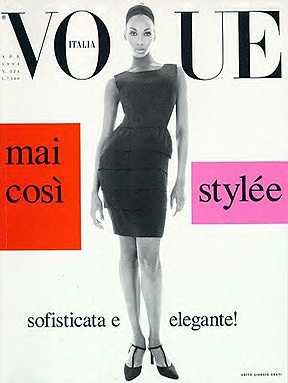
So of course the big news in the fashion world this month was the "Black" issue of Italian Vogue. Forty pages of fashion with only Black models. Folks on both sides of the pond apparently have been scrambling to get a copy of the history-making glossy that features the likes of Iman, Alek Wek, Beverly Johnson and even, (I heard) ANTM Tocarra.
The reason behind the "Black" Issue is infuriating. It seems that here in America the fashion industry, even in 2008, still believes that beautiful Black women can't sell beautiful clothes, or magazines for that matter. Apparently, the editor of Italian Vogue, Franca Sozzani, was making a point that using Black models wouldn't detract from the art of the fashion. Thank you Ms. Sozzani!
A quote from Philadelphia Inquirer Columnist Elizabeth Wellington:
" American fashion is about aspiration ... Unfortunately, no matter how the fashion industry spins it, the clothing designers constructing the most popular runway presentations and the editors creating the most sought-after magazine spreads don't see black women as icons of aspirational beauty. And even more sadly, they don't believe that wealthy women will buy clothing if black women are modeling it."
And that's where I say, WTF? And White women, please don't be offended when I say this, but OF COURSE WHITE WOMEN WANT TO LOOK LIKE BLACK WOMEN. They want to look like us, sound like us, dance like us, cook like us, walk like us, talk like us. Do I need to go on? Black culture has been emulated, copied and co-opted since we set foot on this land. Whether you want to call it sharing or stealing almost every piece of the American cultural pie comes from a Black aesthetic.
I think the fashion industry is just making excuses to remain racist and closed off to "others." Like if they let the colored girls into the club they just might bring in the pork rinds and Hawaiian Punch and spoil the party.
Take a look at Oprah Winfrey. Just for an example. Not only is she Black but she's pretty chunky too. But if girlfriend says Pucci dresses are hot for the summer, at least 100,000 White women would be heading to Lilly Pulitzer for an outfit.
If Beyonce dons a puffy white dress on the red carpet, 80 gazillion teenagers will be wearing white to prom. So I say if the fashion industry embraced Black beauty, the people would follow.
What do you think?
Happy Healthy Weekend!
Peace.
Subscribe to:
Posts (Atom)