Wednesday, November 28, 2007

Little Black Sambo Gets Reinvented as a White Girl


As a Black girl growing up in the '70s and '80s, the only thing I ever knew about Little Black Sambo, was that he was the prototype for every bad, dark-skinded, bug-eyed, red-lipped stereotype of Black people. I'd heard the name and even seen some "Sambo" images and figured that Little Black Sambo was probably the creation of some Evil White Devils who were still angry that the Yankees won the big war.

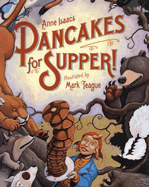
So imagine my surprise when just last week I was reading Anne Isaacs 2006 children's book, Pancakes for Supper and discovered that it was based on the original Little Black Sambo book by British author, Helen Bannerman. Intrigued, I found the text of the original story which was actually set in India, not America making Sambo, Indian not Black, and like Pancakes for Supper, found the story to be quite delightful. (Quite frankly, any story that ends with people eating a whole lot of pancakes is going to get two thumbs up from me.)

And yet I felt so wrong for liking it. Like I was being a traitor to my own race. And I felt somehow Ms. Isaacs shouldn't be able to profit from this controversial story, much less with Sambo re-imagined as a rosy-cheeked White girl. Blasphemy, I thought. Or heresy. Or some sort of moral/racial literary crime must have been committed.

But Anne Isaacs isn't the first to re-tell the Sambo story and she probably won't be the last. My feelings are probably irrational and unfair, but they're my feelings just the same and I wouldn't use them to do anything but provoke a conversation.

So does anybody else out there have a Sambo story to share?

Peace.

Tuesday, November 13, 2007

The One Drop Review

There are many reasons to read Bliss Broyard’s well-written book, One Drop: My Father’s Hidden Life—A Story of Race and Family Secrets. Discovering why famed New York Times book critic and writer, Anatole Broyard chose to reject his Black/Creole heritage and live his life as a White man should not be one of them.

As his daughter, Bliss Broyard takes up the almost impossible task of trying to get into her father’s heart and mind to discover why he crossed the color line. The fact that the man was already dead when she began her inquiry makes the job even more difficult.

Knowing that the likelihood of ever discovering her father’s real motivations for passing were slim, Bliss Broyard instead reconstructs his family history going back several generations to find the first Broyard in 1750s New Orleans. She tells the history of her family and that of the growing territory of New Orleans in fascinating detail, bringing history to life. I for one learned so much about the social and racial politics of one of America’s most culturally diverse cities. Between the French, Spanish, African, Native American and European cultures, New Orleans was probably the spiciest section of America’s original Meltingpot.

Deftly woven between the historical recap, Broyard recounts her own personal journey of getting to know the family she never knew thanks to her father’s decision to distance himself completely from his Black relatives. Not everyone is willing to embrace this long-lost cousin and Broyard doesn’t gloss over the sometimes uncomfortable family reunions.

Perhaps Bliss did not intend to malign her own father, but because he has already passed away he could not speak for himself. As a result, by the end of the book, not only did I not feel I understood Anatole Broyard’s reasons for living the life he did – including his own racist attitudes towards Black people – I didn’t like him very much. His one decision to “walk on the other side,” negatively influenced his family, his children and even his own career as a writer and yet he never mastered the courage to be honest about who he really was.

In some ways, this book reminds me of Rebecca Walker’s memoir, Black, White Jewish. In reading about her harrowing childhood, the reader can’t help but feel disdain for her mother, Alice Walker, no matter how much one respects her as a writer. The same can be said for One Drop and Anatole Broyard. After reading his daughter’s book, the sins of the father are too much to ignore.

As a memoir, I was left wanting more personal revelations about Anatole Broyard. But overall, an excellent, historical retrospective of race and culture in America.

Peace.

Wednesday, November 07, 2007

Kinky Guacamole? Afro-Mexicans in Black & White

I just came across this fascinating October 8th LA Times article about a photographer named Tony Gleaton.

The article, written by Sean Mitchell, begins:

Race is not an issue for Tony Gleaton, the photographer told students at Loyola Marymount University recently. Yet an irresistible musing on the meaning of race has been his destiny. Born with blue eyes and a fair complexion, Gleaton, 59, has spent his life explaining to people that both of his parents were black and that he is "not biracial," while wondering why anyone should care. It's not surprising, perhaps, that Gleaton has made his reputation with a series of portraits of black Mexicans, descendants of slaves brought to Mexico by the Spanish conquistadors 500 years ago, "before the first black slaves came to Colonial Williamsburg," he pointed out.

Gleaton's photographs of Black Mexicans are amazing and are on display at the Burns Fine Arts Center at California's Loyola Marymount University through Nov. 18.

If you're like me and want to find out more about the history of Black Mexicans and you can't make the exhibit, check out this informative Smithsonian link on Gleaton and the history of Africans in Mexico.

So cool.

And just because I don't want to leave you clamoring for more information with nowhere to turn, try this link for further information about the Afro-Mexican experience and even more photographs.

Peace.

Tuesday, November 06, 2007

The Newest Member of the Kinky Gazpacho Family


Just an update.

We got a dog.

Actually, I went out with my 6-year old son to buy some school clothes and we came home with a new dog. Needless to say, he was an impulse buy.

So why am I sharing this on the Meltingpot? Because Diego (that's the dog) isn't just any old puppy. He's a Havanese! If you've never heard of a Havanese dog, you're not alone. Until Diego jumped into my arms, I hadn't either. And I know dogs. As it turns out, the Havanese is the national dog of Cuba. It is a breed that apparently is now rare in Cuba and more popular in the United States and the U.K. but still, he's a completely Cuban (via the Spanish aristocracy) creation. And...wait for it...he's black/Black.

Do you see the karmic synergy here? He's a Black Cuban (with roots in Spain) like my whole family of SpaNegros. He fits right in. He is my third Black/Spanish "son." How could I not adopt him?

Wish me luck in my new role as mother to a multicultural dog.

Peace/Paz!

p.s. the dog in the foto is a model, not Diego.