Recently one of my cousins whispered a shameful confession. "I think from now on I'm going to look for a White girl to color my hair." My cousin wears her hair in a glorious display of natural curls, radiating the colors of sun, copper, sand and chocolate. She's only been coloring her naturally black hair for about a year now and has tried several different salons in Philadelphia and New York to find the person who can give her exactly what she wants. She's not a diva, but she has standards and needless to say she's been disappointed several times and once after a particularly bad coloring session refused to take off her hat for a week!
But now, she's seen the White, er, I mean light. While visiting her mother in Wisconsin, she went to a White hairstylist who did her color for her. And my cousin loved the results. Apparently this woman has been doing a brisk business for many Black women who want to experiment with color and aren't afraid to let a White woman do their hair. Now some people may wonder why would we be afraid to let White people style our hair if we would allow them to color it? That's a really long story that I dare not get into here in this blog post but suffice it to say, this White hairstylist actually told my cousin when she was done with the color, "I really don't know what to do with your hair now. Do you have any ideas?" My cousin did not hold it against her, knowing what she was getting into and happily went home, styled her own hair, loving the fantastic color with its subtle highlights and tints woven through.
So my cousin has come up with this theory that since White women have been playing with color for so long, and I mean really playing with it, whereas Black women tend to use color as a cover up for gray or a drastic change, (blond, pink, magenta), White hairstylist have a professional advantage over their Black sisters. But they still haven't gotten the styling thing down. So now my cousin is in search of a truly multicultural salon where she can get her hair colored by a White girl and styled by a sister.
Does this make sense to anyone else? Me being the laziest hair person ever, who considers the ponytail the most perfect invention of all times and spends very little time or money at the hair salon, finds this a very interesting theory. And it sounds valid. But I'd like some feedback from the Meltingpot village. And if you really do want to understand why all things hair related are elevated to higher levels of importance in the Black community, read my book, Hair Story: Untangling the Roots of Black Hair in America (see the link at the right), and/or get ready to watch Chris Rock's latest documentary, Good Hair which just debuted at Sundance and won an audience award.
Have a Happy Weekend!
Peace & Hair Grease!
Friday, January 30, 2009


Wednesday, January 28, 2009
This Is What Depression Feels Like
I just finished asha bandele's new book Something Like Beautiful. It is subtitled: One Single Mother's Story and indeed it depicts bandele's struggle as a single mother, raising her daughter Nisa alone after the dissolution of her marriage. She receives no help from her ex because he lives in a prison. He is a convicted felon and bandele actually met and married him in prison. She details all of this in an earlier memoir caled, The Prisoner's Wife.
In Something Like Beautiful, bandele doesn't so much tell us what happened next chronologically as meditate on her feelings of loss, hopelessness and fervent desire to, despite it all, be a good mother to her daughter. The first lines of the book, "This is a book about love and this is a book about rage," kind of give you a sense of where bandele is heading. She is a poet and despite the fact that she's dealing with abusive relationships, single parenting, the criminal justice system, substance abuse and a whole host of other societal ills, the book is not ugly. It is actually, something like beautiful.
Personally, I wanted to know more specifics, more details, more linear travel instead of jumping form scene to scene, emotion to emotion and the stream of consciousness letters to her daughter. But then again, that's what depression feels like, apparently. It's not linear, and it doesn't always make sense. I do not in any way identify with bandele -- except that she too is a Black woman -- but now I feel like I can honestly say that I feel her pain, which is something that we all need to be able to do for other women in the same place. We need to learn how to be compassionate, instead of judgmental.
The book is a quick read that will probably have you searching out more of bandele's work. She also writes fiction and poetry. I didn't love this book but I appreciated the raw honesty poured into it and I felt I learned something about the painful choices women make for love.
Peace!
In Something Like Beautiful, bandele doesn't so much tell us what happened next chronologically as meditate on her feelings of loss, hopelessness and fervent desire to, despite it all, be a good mother to her daughter. The first lines of the book, "This is a book about love and this is a book about rage," kind of give you a sense of where bandele is heading. She is a poet and despite the fact that she's dealing with abusive relationships, single parenting, the criminal justice system, substance abuse and a whole host of other societal ills, the book is not ugly. It is actually, something like beautiful.
Personally, I wanted to know more specifics, more details, more linear travel instead of jumping form scene to scene, emotion to emotion and the stream of consciousness letters to her daughter. But then again, that's what depression feels like, apparently. It's not linear, and it doesn't always make sense. I do not in any way identify with bandele -- except that she too is a Black woman -- but now I feel like I can honestly say that I feel her pain, which is something that we all need to be able to do for other women in the same place. We need to learn how to be compassionate, instead of judgmental.
The book is a quick read that will probably have you searching out more of bandele's work. She also writes fiction and poetry. I didn't love this book but I appreciated the raw honesty poured into it and I felt I learned something about the painful choices women make for love.
Peace!
Monday, January 26, 2009
Black People Come in So Many Different Flavors
Thanks to the election of Barack Obama, people the world over are being forced to acknolwedge that Black people really do come in many different flavors. The Black experience does not always start in the ghetto and end in a)the ghetto, b)the 'hood or c)a southern fried kitchen lorded over by Big Mamma and Tyler Perry.
Debut filmmaker, Barry Jenkins is doing his part to broaden the landscape of the Black experience with his new film, Medicine for Melancholy. Reviewed in the New York Times yesterday, the film follows the 24 hours after a one-night stand between two Black twenty-something "hipsters" in San Francisco. It's as much about their budding relationship as it is about being Black in mostly White San Francisco. The movie tackles issue of race, class, identity and regionalism. From the review written by Dennis Lim:
" ...Medicine for Melancholy concerns the search for self-definition. But it stands apart for its forthright attention to the push-pull of inclusion and exclusion that comes with being a minority member of a subculture."
The movie opens in New York this Friday and looks like it will only have a limited release in select cities. So if you live in NYC, San Francisco, Seattle and/or Los Angeles, get thee to a movie theater quick.
Peace!
Debut filmmaker, Barry Jenkins is doing his part to broaden the landscape of the Black experience with his new film, Medicine for Melancholy. Reviewed in the New York Times yesterday, the film follows the 24 hours after a one-night stand between two Black twenty-something "hipsters" in San Francisco. It's as much about their budding relationship as it is about being Black in mostly White San Francisco. The movie tackles issue of race, class, identity and regionalism. From the review written by Dennis Lim:
" ...Medicine for Melancholy concerns the search for self-definition. But it stands apart for its forthright attention to the push-pull of inclusion and exclusion that comes with being a minority member of a subculture."
The movie opens in New York this Friday and looks like it will only have a limited release in select cities. So if you live in NYC, San Francisco, Seattle and/or Los Angeles, get thee to a movie theater quick.
Peace!
Friday, January 23, 2009
Weekend Reading
Just a little something to read over the weekend from The New York Times about just how wonderfully multicultural the first family is. This is the reality of so many people, it's about time we acknowledge the true diversity of the American family. With connections to so many different languages, cultures, countries, and religions, how can Barack Obama not be a better president?
Peace!
Peace!
Thursday, January 22, 2009
Food for Thought -- Pig Feet

Growing up in my mostly White, suburban surroundings, I always thought that the fact that the majority of my family members considered certain pig parts a delicacy, should remain a shameful secret.
When it came time to talk about what we ate to celebrate the holidays, I never talked about the big pot of pig feet that my mother and all of her sisters prepared, for our New Year's day feast. And I certainly never tasted the offensive things, thinking that there really couldn't be anything more disgusting, except for perhaps the chittlins (intestines) which not only smelled bad, but looked revolting too.
Until later.
When I became an adult myself, having traveled the world and tasted things far stranger than a pig's foot, I decided to give this time-honored family dish a try. And guess what? I loved it. But I still kept that love a secret, for fear of seeming uncouth, vulgar, or just too damn country/uncivilized. I didn't analyze my feelings that much, I just knew eating pig feet didn't sound like something one should bring up in conversation. I considered it a family matter.
I found myself revisiting those feelings of shame the other day at the market in a chi-chi area of Philadelphia, where I was looking for pig feet. As I looked into the face of the blue-eyed, blond-haired butcher, I found myself stumbling over my request. "Do you have any..." I searched my mind for a euphemism for pig feet, "... fresh ham hocks?" I said. He shrugged his shoulders and said, "No, but I have some fresh pig feet. Do you want those?" Relief. He said it first. He wouldn't think I was crazy for asking. I took them home and whipped up a scrumptious pot of spicy red beans with the pig feet. Served with stir fried greens and blue corn pancakes. Yummy. It kind of reminded me of a Brazilian dish I ate once in New York. And that's when it hit me.
A lot of people eat pig's feet, intestines and in Spain, where my hubby is from, they eat sandwiches made from pig ears! Real Mexican pozole isn't right without a pig foot and the pig's head! So why am I freaking out over the fact that I enjoy noshing on pig toe every now and again? Why is it okay to say I eat menudo (aka Mexican pig intestines) and not chittlins? Is it exotic when other cultures eat it, but just wrong here in America?
Do you have a cultural food/dish that you keep on the down-low because you think people might be freaked out by the idea? Are people discriminated against because of what they eat?(If I'm honest, if people tell me they eat Wonder Bread, I do turn up my nose a bit, but I'm working on that.) Is there such thing as a minority food culture? Please share your thoughts and let's put this food shame to rest.
Peace!
Recipe Alert. Here's a recipe for traditional southern style pig feet. I haven't tried it, but it looks good, except for the barbecue sauce part. I'd ignore that, unless of course you enjoy barbecue sauce.
Tuesday, January 20, 2009
Can We All Claim Him?

Of course, I watched hours of Obamarama TV all day long. Of course, I was moved to tears, cheers, and jeers (whenever they showed a shot of the pitiful Mr. Cheney). I am still tingling and swear the sun started shining a little bit brighter after 12:04pm when Barack Hussein Obama became the 44th president of the United States.
But here is my question? Have you all noticed the media is in the midst of a labeling crisis with our new president? Have you witnessed how they stumble and stammer as the declare him the first er, um, African-American, or is it Black, or Biracial president? I have heard news broadcasters use all three terms but they all appeared pained as if they weren't sure they were saying the right thing.
As a former fact-checker, I feel their pain. How do we refer to President Obama when we are trying to place him in the annals of history? I mean, technically, in the truest sense of the word he is an African-American, dad is from Africa, mom hails from the U.S. of A. But we all know that's not what the label means. Is Black a better option, since Black can and often does encompass all of those people involved in the African Diaspora? Of course, Mixed or biracial is probably the most accurate term and if we weren't speaking of the president of the United States, let's say he was a champion golfer for example, I think we probably wouldn't be having this discussion.
Despite the fact that we've been inter-mixing since the Pilgrims hit Plymouth Rock, I think we are still quite uncomfortable acknowledging the effects. Or are we just too stuck in our old one-drop ways to legitimize the Mixed identity? Of course to you, my Meltingpot readers, this may be a moot point, but the rest of our fellow citizens, as evidenced by our stuttering media, seem to be having a hard time with this.
It is my belief that the person to answer this question is President Obama himself. He should send an executive memo to the press (who will then disseminate the info to the masses) that from now on he wishes to be referred to as, African-American, Black, Biracial, Mixed, African, Hawaiian, Mix-y, Person of Color, HNIC (Head Negro in Charge), whatever. I don't see see it as anyone else's decision, but I do think the issue should be addressed. I'd hate to think Mr. Obama has built an identity for himself that is now being ignored. Maybe he hasn't. Maybe he doesn't care. Maybe I'm making an issue out of nothing.
What do you think?
Peace!
Monday, January 19, 2009
Happy MLK Day!
"Almost always, the creative dedicated minority has made the world better." -- Dr. Martin Luther King, Jr.
Please tune in tomorrow for special inauguration coverage.
Peace!
Please tune in tomorrow for special inauguration coverage.
Peace!
Friday, January 16, 2009
Tidbits from the Meltingpot
Happy Friday,
Today I have lots of information to share so here we go:
- Our first Meltingpot Giveaway Winner is "Dee!" Dee wins a free autographed copy of Hair Story: Untangling the Roots of Black Hair in America. If you wanna track back and check out her personal hair story, it's worth a read, but I selected the winner randomly out of a hat (a very small hat, since only three people posted, but I'm not complaining.)So Dee, send us an email to myamericanmeltingpot@gmail.com with a mailing address and you'll get your amazing, award-winning, free book in a jiffy.
- New Links. Check them out!
- The Mixed Roots Film & Literary Festival is back. Actually the 2009 festival will be held in June, but festival organizers, Heidi Durrow and Fanshen Cox of Mixed Chicks Chat are asking for submissions from film and literary folk who'd like to present their work at the festival in Los Angeles. For full details, check out the new website at mxroots.org.
- My Kinky Gazpacho family is all the rage in the new age of Obama. Check out the article in the Philadelphia Inquirer. I've counted at least a half dozen similar stories in newspapers across the country documenting the multi-racial family experience. For those of us living it, doesn't it feel a little bit like old news? But I guess the positive spin is always good. Anybody disagree?
- Weekend Plans: I am heading to Washington D.C. to talk some more about identity politics and my personal journey at a new multiracial bookstore in Georgetown called, Presse Books. The reading is on Sunday January 18, at 2pm. Please show up if you're going to be in the area. I just found out Beyonce will be performing a free concert at the same time, where Obama is opening the show and I'm wondering if we're competing for the same audience? I mean I think I could take Beyonce but Barack and Beyonce? At least my event is indoors!
Happy Friday and stay warm!
Today I have lots of information to share so here we go:
- Our first Meltingpot Giveaway Winner is "Dee!" Dee wins a free autographed copy of Hair Story: Untangling the Roots of Black Hair in America. If you wanna track back and check out her personal hair story, it's worth a read, but I selected the winner randomly out of a hat (a very small hat, since only three people posted, but I'm not complaining.)So Dee, send us an email to myamericanmeltingpot@gmail.com with a mailing address and you'll get your amazing, award-winning, free book in a jiffy.
- New Links. Check them out!
- The Mixed Roots Film & Literary Festival is back. Actually the 2009 festival will be held in June, but festival organizers, Heidi Durrow and Fanshen Cox of Mixed Chicks Chat are asking for submissions from film and literary folk who'd like to present their work at the festival in Los Angeles. For full details, check out the new website at mxroots.org.
- My Kinky Gazpacho family is all the rage in the new age of Obama. Check out the article in the Philadelphia Inquirer. I've counted at least a half dozen similar stories in newspapers across the country documenting the multi-racial family experience. For those of us living it, doesn't it feel a little bit like old news? But I guess the positive spin is always good. Anybody disagree?
- Weekend Plans: I am heading to Washington D.C. to talk some more about identity politics and my personal journey at a new multiracial bookstore in Georgetown called, Presse Books. The reading is on Sunday January 18, at 2pm. Please show up if you're going to be in the area. I just found out Beyonce will be performing a free concert at the same time, where Obama is opening the show and I'm wondering if we're competing for the same audience? I mean I think I could take Beyonce but Barack and Beyonce? At least my event is indoors!
Happy Friday and stay warm!
Wednesday, January 14, 2009
Pelo Bueno, Pelo Malo and the First Meltingpot Giveaway

So, on our way home from the holidays, my husband struck up a conversation with a fellow traveler who happened to be from Venezuela. My husband swears he cannot remember how the conversation started but eventually the topic turned to hair. Maybe she was looking at my hair, beautiful as it is in shoulder length dredlocks. Or perchance she was fascinated by the different textures of hair on the heads of my two children. Whatever the reason, the terms "pelo bueno" and "pelo mala," entered the discussion.
"Do you know what we mean in Venezuela when we say 'pelo malo,' the woman whispered to my Spaniard. "Pelo malo is hair that is so kinky that it doesn't even get wet. Water just ripples off of it." And she wasn't speaking metaphorically. She meant that in a technical way, that indeed there is a certain grade of (obviously African) hair that is so dense that water cannot penetrate.
She then reached over to pat my older son's head, to ascertain just what type of hair he had. The Spaniard claims my son was blissfully unaware of the conversation going on around him. She proclaimed, "Oh no, his hair isn't 'malo,' it's thick but water could still get through." Really, she said that.
Had I known what was being discussed, I definitely would have jumped into the conversation, but apparently I was too busy drooling in my own seat across the aisle. As it turns out, there are several grades of hair between 'pelo bueno' and 'pelo malo,' where the 'bueno' hair is nice and straight like that of the European conquistadors who introduced it to the Venezuelan double helix. (See image above for visual aide.)
I am so not criticizing this woman, just posting about here on the Meltingpot for public debate and discussion. Anybody who knows anything about Black Americans and our hair knows that as a community we're still employing the terms, 'good hair' and 'bad hair,' where bad hair is ultra kinky and good hair is loose and curly and kind of Indian looking. Right? I just think this story illustrates how similar we all are, despite our desperate and futile attempts to segregate ourselves. Can I get a witness? I feel like I'm about to preach a sermon, but I will refrain from spreading the hairy gospel.
Instead, I will drop some knowledge in the form of a free book giveaway. The first one ever (and not the last) here on the Meltingpot. Post your craziest personal hair story in the comments section by the end of day tomorrow (Thursday January 15) and I will select a random winner to receive an autographed copy of the book, Hair Story: Untangling the Roots of Black Hair in America. Yes, I wrote it, but it's a great book that documents the amazing history, culture, politics, and business of Black hair, including the origins of the terms 'good hair' and 'bad hair.' I'll post the winner on Friday, so send in your stories lickety split.
Peace and Hair Grease!
Monday, January 12, 2009
I've Been Tagged- Six Random Things About Me
Hi Meltingpot Readers,
When I started this blog, I kind of wanted to keep my personal life on the down-low. I didn't want to write a navel-gazing kind of blog, where I waxed philosophical about my kids' bowel movements and what I ate for dinner last night. I wanted to create a more magazine-style, personality-driven blog, that would incite conversations and make people think. I don't know if I've been successful and admittedly I have mentioned my children a few times, but now I've been tagged by my friend Heidi and I feel I must reveal a bit about myself. But in keeping with the theme of the Meltingpot, my big confessions will be somewhat multi-culti in nature. So here we go. Six random things about me:
1. The first boy I ever kissed was a Spanish exchange student from Madrid. (He obviously left a great impression because I subsequently married a Spaniard. No relation to the exchange student.)
2. When I was in first grade I was chosen to play "Black Peter" in our Christmas play about the Netherlands. Black Peter is St. Nick's helper who carries a bag of sticks and whips all of the naughty boys and girls. I'm guessing I got to play the role because I was the only Black child in my class. Or maybe because I just looked good carrying a bag of sticks.
3. When I lived in Morocco as an exchange student, I got really good at eating with one hand. Almost twenty years later, I still really don't like forks or knives. Some people might think I have bad table manners, I just think I was born into the wrong culture.
4. I love Korean food, the spicier, the better.
5. Whenever my husband and I see a mixed-race couple, we slap each other. It's a game we started years ago and haven't been able to get ourselves out of the habit.
6. I really want to adopt a daughter but my husband really doesn't.
So there you have it. That was really hard. But I hope it brings somebody some bit of enjoyment. If you want to know even more about my personal life, check out my personal blog where you can read my entire life story and keep up on my literary pursuits. Meanwhile, here on the Meltingpot, I promise on Wednesday we'll be back to our regular scheduled programing.
Peace!
When I started this blog, I kind of wanted to keep my personal life on the down-low. I didn't want to write a navel-gazing kind of blog, where I waxed philosophical about my kids' bowel movements and what I ate for dinner last night. I wanted to create a more magazine-style, personality-driven blog, that would incite conversations and make people think. I don't know if I've been successful and admittedly I have mentioned my children a few times, but now I've been tagged by my friend Heidi and I feel I must reveal a bit about myself. But in keeping with the theme of the Meltingpot, my big confessions will be somewhat multi-culti in nature. So here we go. Six random things about me:
1. The first boy I ever kissed was a Spanish exchange student from Madrid. (He obviously left a great impression because I subsequently married a Spaniard. No relation to the exchange student.)
2. When I was in first grade I was chosen to play "Black Peter" in our Christmas play about the Netherlands. Black Peter is St. Nick's helper who carries a bag of sticks and whips all of the naughty boys and girls. I'm guessing I got to play the role because I was the only Black child in my class. Or maybe because I just looked good carrying a bag of sticks.
3. When I lived in Morocco as an exchange student, I got really good at eating with one hand. Almost twenty years later, I still really don't like forks or knives. Some people might think I have bad table manners, I just think I was born into the wrong culture.
4. I love Korean food, the spicier, the better.
5. Whenever my husband and I see a mixed-race couple, we slap each other. It's a game we started years ago and haven't been able to get ourselves out of the habit.
6. I really want to adopt a daughter but my husband really doesn't.
So there you have it. That was really hard. But I hope it brings somebody some bit of enjoyment. If you want to know even more about my personal life, check out my personal blog where you can read my entire life story and keep up on my literary pursuits. Meanwhile, here on the Meltingpot, I promise on Wednesday we'll be back to our regular scheduled programing.
Peace!
Friday, January 09, 2009
Shocking News from the Mixed-Race Baby front...again
I was scanning a newspaper on the train the other day, and an article with the following headline caught my eye: "Mixed-Race Couple has mixed-race twins again."
Of course I read the article, and discovered that a couple in London, where mum is White and Dad is Black, just had their second set of twin daughters where one looks Black and the other White. Remembering the last time this kind of story broke and the twins weren't all that different looking, I didn't think this case would be much different. But I googled the couple and found this story with a picture. And it is pretty amazing.
As the mother of two boys who also are different colors (not so dramatically), I bristle when people point this out to me. When they say, "oh how cute, one looks like you and one looks like your husband," I don't find it cute.
So I feel some sort of shame at being fascinated by stories like these. What do you think? Should two babies born with different pigmentation be page one news stories? Is there a proper way to frame the story, from a scientific wonder perspective that takes away the "freak of nature" aspect to it, perhaps? Thoughts?
Peace!
Of course I read the article, and discovered that a couple in London, where mum is White and Dad is Black, just had their second set of twin daughters where one looks Black and the other White. Remembering the last time this kind of story broke and the twins weren't all that different looking, I didn't think this case would be much different. But I googled the couple and found this story with a picture. And it is pretty amazing.
As the mother of two boys who also are different colors (not so dramatically), I bristle when people point this out to me. When they say, "oh how cute, one looks like you and one looks like your husband," I don't find it cute.
So I feel some sort of shame at being fascinated by stories like these. What do you think? Should two babies born with different pigmentation be page one news stories? Is there a proper way to frame the story, from a scientific wonder perspective that takes away the "freak of nature" aspect to it, perhaps? Thoughts?
Peace!
Wednesday, January 07, 2009
A Delicious Memoir by Kim Sunee
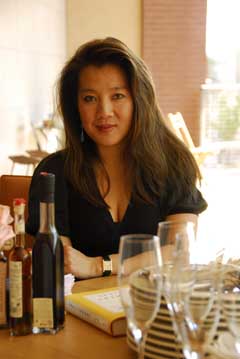
You know a book is really well written when you find yourself licking the pages. That's how tasty Kim Sunee's memoir, Trail of Crumbs: Hunger, Love and the Search for Home really is.
Sunee was abandoned at age three by her mother in a market in South Korea. She was then adopted by a young, White American couple who also adopted another Korean child, a younger sister for Kim. Sunee's parents brought Kim and baby Suzy home to New Orleans where she bonded almost instantly with her maternal grandparents. And it was her grandfather who introduced her to the thrill of cooking and feeding family around the table.
Despite what seems like everyone's best intentions, Sunee never felt rooted to her family and seems permanently predisposed to take flight. She leaves home at 17 for college in Florida, and makes it a point to stay away as long as possible. The book really begins with Sunee at age 23 living in the south of France with her decidedly older, wealthier and still married boyfriend, or rather, manfriend, Olivier. She also becomes the de facto stepmother to his young daughter. Sunee spends her days and nights, basically a kept woman, who proves her worth by cooking elaborate meals for Olivier's eclectic assortment of friends and family.
Interspersed between the tumultuous love affair between Sunee and Olivier are mouthwatering recipes Sunee has collected throughout her life. We get "Quick-Fix Kimchi," "Crawfish Stuffing," and "Figs Roasted in Red Wine with Cream and Honey," just to name a few.
Now, even though there is a chapter devoted to Sunee's return to Korea and an underlying theme to the entire narrative is Sunee's need to define herself, this is not an adoption memoir as much as it is a coming of age tale of a young woman with her own personal demons to exorcise. If you want to read a book about racial identity and dealing with the effects of adoption, transracial or otherwise, this is not the book to read. Sunee barely touches on her Asian identity and what it means to her or how she feels as an Asian woman in France and other places she travels. I wish she had but I respect her right not to include that in this version of her story. And she hints at the problems she has/had with her adoptive family but never digs deep. Perhaps she needed to protect that part of her life.
The story that Sunee chose to tell is probably one more people can relate to actually, especially women. Sunee writes basically about how she allowed herself to be defined by a man and the struggle that ensued to free herself. I read the book and felt like I was caught up in a French-themed soap opera, with dramatic characters, a beautiful setting and those sumptuous recipes for added spice.
Sunee is a poet and it shows in her sensuous descriptions of everything from the sun-ripened peaches she plucks from the trees on Olivier's estate to the smell of her grandmother's refrigerator back home. Sometimes I had to remind myself that I was reading a true story because some of it seemed almost too over the top to be real. Not in a James Frey kind of way, but more like when Olivier decides Sunee should work in a poetry shop so she won't feel bored, so he buys her her own poetry shop in the heart of Paris! Nice, right?
I really enjoyed this book and recommend it for anyone who loves memoir and is looking for a well-told story that blends travel, language, food and love into one delicious dish.
Peace!
(p.s. Please note there is an accent mark on the first "e" in Kim's last name, but I can't figure out how to put it on there. A thousand apologies.)
Monday, January 05, 2009
Obama Takes a Shit in Spain...No Really!

(Warning: this Meltingpot makes liberal use of the word shit. If this word offends you, perhaps you should skip this post. My apologies.)
Welcome Back Meltingpot Readers,
I've missed you all while I was in Spain for the holidays. I really, really did. Especially when I discovered a peculiar custom common to Spain during the Christmas season. It seems, that in addition to a Christmas tree, most Spanish households erect an elaborate manger scene during the holidays. This makes sense especially since in Spain, it's the three kings (those are the guys who brought the gifts to the baby Jesus, for all of my non-Christian readers) who bring presents on January 6th and not a big fat guy in a red suit. Although, truth be told, Santa has invaded Spain and is gaining in popularity. But I digress.
So, anywho, apparently no manger scene is complete without -- of course the figures of Mary and Joseph, the baby Jesus and the three kings, but also a man taking a shit, aka, "the shitter." I'm not kidding. The most popular figurine in a Spanish manger scene, is the man taking a dump, affectionately known as "the shitter." Really, I'm not making this up. Apparently the shitting guy adds an air of authenticity to the manger scene, because obviously there weren't any bathrooms during biblical times. Right? I'm guessing here, because nobody could tell me exactly why this shitting man must be in the scene. But they could tell me that the tradition came from Barcelona where every year they erect a giant manger scene in a public square and the face of "the shitter" is always some famous person. Every year it's someone different -- a politician, a movie star, a king. It's considered an honor to be "the big shitter" in Barcelona. And this year, "the big shitter" is Obama!
You gotta love Spain.
Anybody else ever hear of this tradition in any other country? Please share!
Happy New Year Meltingpot Readers.
Subscribe to:
Posts (Atom)