Hello Meltingpot Readers,
Sorry for falling off the face of the blogosphere. Between Thanksgiving preparations and working on the final edits of my novel (which is due in two weeks) the Meltingpot got left behind. I apologize profusely. But let's not dwell on the past. Instead, let's talk about the winner of my Kinky Gazpacho Giveaway.
Ms. E. You won! So please send us an email at myamericanmeltingpot@gmail.com with a mailing address and we will send you a copy of Kinky Gazpacho, the book and the t-shirt from ?RU.
And speaking of giveaways...I'm in a giving mood this season and have some wonderful books to give away that would make wonderful gifts. We're talking memoirs, how-tos and spirituality focused tomes. Books that are guaranteed to make you feel good after reading.
So please stay-tuned to the Meltingpot. Thanks!
Peace!
Monday, November 30, 2009


Monday, November 23, 2009
The Secret Life of Obama's Brother
Am I the last Obama fan to know that our president has a biracial (Jewish and Kenyan) half brother, Mark Ndesandjo, who lives in China and is married to a Chinese woman?
I mean I've read his memoir. I've read all the Obama children's books. I even keep my own Obama scrapbook and yet when I caught the brief headline in Time magazine last week, that Obama stopped by to visit his half-brother in China during his official Asia trip, I did a double take.
Now, I'm generally not a pessimist, but doesn't it just seem like every president has to have a creepy and/or slightly embarrassing brother hiding in a closet, just waiting for the right time to expose his creepy and/or embarrassing habits on the public stage? I'm not saying this is true about Obama's brother, at all. I'm just saying I wouldn't be surprised if a little something scandalous doesn't come out soon.
Right now the media seems to be respecting his privacy. The fact that he lives in a small province in China probably makes it easier for him to lay low, although now that he has his own new self-published, semi-autobiographical novel to promote, he may want a little bit more publicity. Can I just ask, why can't presidential siblings just have really normal jobs and boring lives that nobody would care about?
I'm not going to judge, but as Dick Cheney might say, I'm staying on high alert. What do you think? Will we hear more from and about Mark Ndesandjo? Good stuff or bad stuff? Here's some basic information about him from the Associated Press.
Peace.
PS. You still have a few more hours to post your entry in Friday's comments for a chance to win a book and a t-shirt.
I mean I've read his memoir. I've read all the Obama children's books. I even keep my own Obama scrapbook and yet when I caught the brief headline in Time magazine last week, that Obama stopped by to visit his half-brother in China during his official Asia trip, I did a double take.
Now, I'm generally not a pessimist, but doesn't it just seem like every president has to have a creepy and/or slightly embarrassing brother hiding in a closet, just waiting for the right time to expose his creepy and/or embarrassing habits on the public stage? I'm not saying this is true about Obama's brother, at all. I'm just saying I wouldn't be surprised if a little something scandalous doesn't come out soon.
Right now the media seems to be respecting his privacy. The fact that he lives in a small province in China probably makes it easier for him to lay low, although now that he has his own new self-published, semi-autobiographical novel to promote, he may want a little bit more publicity. Can I just ask, why can't presidential siblings just have really normal jobs and boring lives that nobody would care about?
I'm not going to judge, but as Dick Cheney might say, I'm staying on high alert. What do you think? Will we hear more from and about Mark Ndesandjo? Good stuff or bad stuff? Here's some basic information about him from the Associated Press.
Peace.
PS. You still have a few more hours to post your entry in Friday's comments for a chance to win a book and a t-shirt.
Friday, November 20, 2009
Finding Myself in the Music (And a Giveaway Too)
Thanks to Ieishah over at Fat Juicy Oyster, I can't get this new song, Looking for Paradise, by Alicia Keys and Spanish crooner, Alejandro Sanz, out of my head.
Now, Ieishah thought the song was horrible. I believe the words she used were "cheesy con queso." But somehow it's growing on me. And it's not because of the lyrics (they are cheesy con queso). It's got a catchy little refrain, yes, but more importantly, it's a kinky gazpacho duet that reminds me of me. Am I saying that Alicia is my sister-twin and Alejandro Sanz is a dead ringer for el esposo? No, I'm not that ridiculous. I just love to see Black and Spanish paired up together making beautiful (albeit a little cheesy) music together. It feels like a reflection of my reality.
So Meltingpot readers, do you do the same thing? Do you find yourself in music? Tell me what song speaks to your life story and you'll be entered in a drawing to receive an autographed copy of my life story, Kinky Gazpacho and a Kinky Gazpacho t-shirt from whatrugear.com. All entries must be received by Monday, November 23rd at midnight.
Peace.
Oh, and here's the song Looking for Paradise by Alicia Keys and Alejandro Sanz. Do you think it's cheesy?
Now, Ieishah thought the song was horrible. I believe the words she used were "cheesy con queso." But somehow it's growing on me. And it's not because of the lyrics (they are cheesy con queso). It's got a catchy little refrain, yes, but more importantly, it's a kinky gazpacho duet that reminds me of me. Am I saying that Alicia is my sister-twin and Alejandro Sanz is a dead ringer for el esposo? No, I'm not that ridiculous. I just love to see Black and Spanish paired up together making beautiful (albeit a little cheesy) music together. It feels like a reflection of my reality.
So Meltingpot readers, do you do the same thing? Do you find yourself in music? Tell me what song speaks to your life story and you'll be entered in a drawing to receive an autographed copy of my life story, Kinky Gazpacho and a Kinky Gazpacho t-shirt from whatrugear.com. All entries must be received by Monday, November 23rd at midnight.
Peace.
Oh, and here's the song Looking for Paradise by Alicia Keys and Alejandro Sanz. Do you think it's cheesy?
Wednesday, November 18, 2009
How Do You Translate "Black?"
Am I the only one who missed this disturbing news about the international advertising campaign for the movie Couples Retreat? Personally, I hardly paid attention to this film when it premiered in the United States because Vince Vaughn is in it and quite frankly, I think Vaughn possesses the dramatic range of a yodeling pickle. But I digress.
Apparently, the movie posters for the film in the UK and other foreign markets had the Black couple removed -- both their photographs and their names in the list of credits -- because, well, because apparently Black people just don't appeal to foreigners. Here's how a Universal spokesperson explained their decision to whitewash the poster: We got rid of the Black actors to “ simplify the poster to actors who are most recognizable in international markets.” Oh, And they "regretted causing offense."
For a full read on the incident,and a peek at the before-and-after posters, you can check out this Yahoo story.
Many people in La La Land, aka Hollywood, believe that Black people just don't translate well overseas. That Will Smith just isn't that popular and so we can't put him on magazine covers or on movie posters and expect our British brothers and sisters to buy. And God forbid can you imagine in Japan or China or Turkey? Or at least that's what top brass at the movie companies are saying. But maybe they're saying that because they personally think that and don't have any Black people in positions of power at the studio to tell them otherwise. That's kind of what this writer at the LA Times says in his article about this whole hulabaloo.
What do you think? Especially you world travelers. Would foreign audiences shun a movie with a Black protagonist or supporting actor? Could they handle Black people on their movie posters? Vivienne Pattison, director of Media Watch UK, told the [Daily]Mail: "... We celebrate diversity in Britain and we could have coped with seeing the same poster used in America." Indeed, I find it really hard to believe that considering foreign markets are so hot for Black music, style, fashion, slang, dance, food (yes, my cousin is about to take a job teaching Italian chefs how to make soul food in Italy.), and our hot Black president, that somehow they would be turned off by Black people in a movie. What is the real problem here? Where are we getting lost in translation?
I'm really, really listening.
Peace.
Apparently, the movie posters for the film in the UK and other foreign markets had the Black couple removed -- both their photographs and their names in the list of credits -- because, well, because apparently Black people just don't appeal to foreigners. Here's how a Universal spokesperson explained their decision to whitewash the poster: We got rid of the Black actors to “ simplify the poster to actors who are most recognizable in international markets.” Oh, And they "regretted causing offense."
For a full read on the incident,and a peek at the before-and-after posters, you can check out this Yahoo story.
Many people in La La Land, aka Hollywood, believe that Black people just don't translate well overseas. That Will Smith just isn't that popular and so we can't put him on magazine covers or on movie posters and expect our British brothers and sisters to buy. And God forbid can you imagine in Japan or China or Turkey? Or at least that's what top brass at the movie companies are saying. But maybe they're saying that because they personally think that and don't have any Black people in positions of power at the studio to tell them otherwise. That's kind of what this writer at the LA Times says in his article about this whole hulabaloo.
What do you think? Especially you world travelers. Would foreign audiences shun a movie with a Black protagonist or supporting actor? Could they handle Black people on their movie posters? Vivienne Pattison, director of Media Watch UK, told the [Daily]Mail: "... We celebrate diversity in Britain and we could have coped with seeing the same poster used in America." Indeed, I find it really hard to believe that considering foreign markets are so hot for Black music, style, fashion, slang, dance, food (yes, my cousin is about to take a job teaching Italian chefs how to make soul food in Italy.), and our hot Black president, that somehow they would be turned off by Black people in a movie. What is the real problem here? Where are we getting lost in translation?
I'm really, really listening.
Peace.
Monday, November 16, 2009
Wanted: A Meltingpot Magazine

Just the other day I was searching through my stacks of magazines, looking for some sample stories to show my students at Temple, when I came across my three issues of Suede magazine.
Does anyone remember Suede? If you never saw it, you can check out The Fashion Bomb's post about how great it was. Suede was supposed to be the little sister publication of Essence magazine but it was so much better than that. It was this gorgeous, lush, completely original magazine for women of color. It was fresh and unique and had a truly global and sophisticated but not pretentious voice. I actually served as the books editor, but my stint was short-lived because the magazine was shut down after only four issues, due to budget problems.
I was sooo sad when that happened and still haven't found a magazine where page after page I was enraptured. For a second, however, when I heard that Tyra Banks was debuting her own new 'magaline' (that's an online magazine, people) I thought maybe somebody had heard my prayers.
Not so much. Tyra's new magaline, which I think is called Tyra: Inside & Out seems to be a publication about, well, Tyra. Really, it's mostly about her and how she's going to help you, the reader, get beautiful, inside and out. But maybe I'm missing something.
What do you think of the new Trya magaline? Better yet, what do your read off the newsstand or on-line for your media fix of beauty, entertainment, fashion, pop culture and news with a meltingpot twist? Besides, the Meltingpot, of course:)
I'm listening.
Peace!
Friday, November 13, 2009
Burning Questions from the Meltingpot
It's Friday, people, so that means I have questions. So many questions. Maybe you can help me out.
1. Is it just me, or have you noticed more commercials featuring interracial families on network TV? I just saw a Playskool toy commercial with a little biracial girl and her White mother. And I swear I've seen others recently. Anyone else noticing this trend? And if so, does this mean anything?
2. Does anyone else not really like watching ABC's Private Practice, but sometimes can't help getting sucked into the drama after watching Grey's Anatomy? And if so, did you watch last night and kind of cringe when Taye Diggs leaned over and locked lips with Kate Walsh? Or were you kind of hoping those two might be the new sexy, hot primetime couple? Me? I was definitely on the fence. Not b/c I have a problem with the Black man, White woman thing...no, I just don't like Kate Walsh's character on the show.
3. And while we're on the topic of interracial couples, has everyone gone over to the Mixed and Happy blog and added your peeps to the list of mixed and happy families? They only need 47 more people to post by December 15 to meet their goal of 100 mixed and happy folks.
4. Speaking of happy, doesn't Dominican baseball star Sammy Sosa seem a little too happy about his "accidentally" whiter skin? He claims that his dramatically whitened appearance occurred because his nightly skin cream stripped away the melanin in his face. Oopps! Basically he's pulled a Michael Jackson, going from cinnamon brown to, well, kind of pasty white. Check out the photos at Clutch magazine and let me know if that isn't just a little bit disturbing?
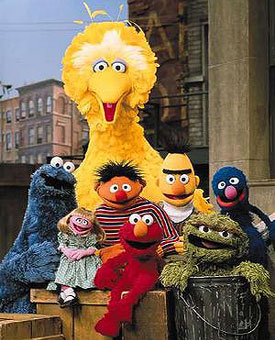
5. And to end on a happy note. Did you know in college I majored in education with the secret fantasy of working for Sesame Street? Well, it never happened, but that doesn't take away from the fact that I still love the show, probably now more than ever. I think I've always loved Sesame Street even as a child, because I saw brown, Black, and White people living together and it seemed like the perfect place to be. As a matter of fact, when the show debuted in 1969, according to Time magazine, " it was one of the first TV shows to depict an inclusive, racially harmonious neighborhood, prompting Mississippi to ban it (briefly) in 1970." (Shame on you Mississippi!)So Happy Birthday, Sesame Street: Here's to 40 more fantastic multiracial, multicultural entertaining, educational and most importantly, hilarious years on television. Do you have a favorite Sesame Street moment?
Peace!
Wednesday, November 11, 2009
My Name is Not "Precious"

So I think I'd have to hand in my 'race and identity' blogger card if I didn't take a moment to write about Precious. In case you've been snoozing under a very big rock (or you live abroad) and hadn't heard all of the buzz and noise about the Precious movie , based on the book Push by Sapphire, here's what you need to know to get caught up.
The book Push came out in the early-mid 90's but took place in the Regan era 80s. It's about a morbidly obese, poor, Black teen named Precious, who has been repeatedly raped by her father, sexually abused by her mother and is pregnant for the second time by her no-good daddy. Oh, and she's illiterate. How's that for a feel good read?
I remember reading that book in one sitting and throwing it against the wall at least three times during that time. It pained me to read. It disgusted me and it saddened me immensely because I knew that this slim little volume was fiction, yet somebody, or rather a lot of somebodies, probably recognized it as truth. Needless to say, the story haunted me for years and I always wondered what would have happened to that girl named Precious. I can't say I liked the book, but I appreciated its ability to take me to a place I've never been to before and make me consider my own life, family and relationships differently.
Well, no pun intended, Precious is Huge today --doing well at the box-office and with critics. Oprah Winfrey and Tyler Perry have teemed up as producers on the film and are widely pimping, I mean pushing the film to mainstream audiences with great success. But even though reviews have been overwhelmingly positive, much of the Black blogosphere and some other media outlets are crying foul.
I haven't seen the film yet and don't want to. The only reason I might is so that I can be more thorough in my criticism. Rather than tell you why I'm so not feeling Precious on the big screen. I will beg you to read journalist Akiba Solomon's fierce review on her blog smallmediumlarge.
Here's a taste of what Solomon wrote:
"I saw Precious on Saturday. Two days later, I’m still traumatized and overwhelmed by the sheer degradation of the thing.
This film is marketed–by Oprah and Tyler Perry–as a story of individual triumph over savage abuse. Thanks to newcomer Gabourey Sidibe’s excellent performance, I somehow believed that Clareece Precious Jones—a morbidly obese, illiterate, often greasy incest victim with skin the color of soil–reflected some form of reality. And to me that’s what’s so dangerous and seductive about this fucking thing.
Precious heaps so much context-free, visually engaging emotional and physical abuse on its 16-year-old protagonist that I couldn’t think straight. When her nasty, faceless, AIDS-infected daddy rapes her, when she gives birth to her second child by said daddy, when her sexually abusive, sadistic, welfare cheat of a mama beats the shit out of her, I was so fucked up, so fucking sad, so at a loss for any word or thought besides fuck! that I forgot that this fucking film was an overwrought throwback to Reagan-era tall tales of urban savagery and Black maternal neglect.
Solomon concludes towards the end of her review:
"One could argue that Precious should be evaluated as an individual work of art, a faithful adaptation of Sapphire’s problematic Push. But the same way I won’t laud the technical accomplishments of Birth of a Nation or blissfully ignore how Breakfast at Tiffany’s features Mickey Rooney as a bumbling Chinese neighbor who enters each scene with a gong, I won’t allow the transcendent performances in Precious to distract me from what it says and repeats about [Black People]."
I urge you to read the entire piece and the follow -up postings about the film and its critics at SmallMediumLarge. Oh, and by all means, check out the comments.
I swear between Chris Rock's Good Hair and now Precious, I feel Hollywood is throwing out the worst stereotypes of Black life for public consumption. And it's Black people behind it this time! And I'm not saying we can't have real-life stories up on the big screen, but what is the point of a film like Precious? I don't care what Oprah says, "We are not all Precious." I don't see any Precious in me. None. In fact, I pray to God most people can't find a scrap of themselves in Precious. Author Carleen Brice writes about this on her blog today.
At the end of the day, maybe Precious wouldn't get so much hype and attention if there were more movies about Black people to choose from. And maybe some of those movies wouldn't have to be about pathology and degradation but about things like, oh, I don't know, the power of bedtime stories or two people falling in love via the internet, or maybe a young Black woman's search for true love in Spain. Just for example.
I am throwing my hands up and shouting, "Why?" (School Daze flashback, anyone?)
(sigh) Can anybody convince me that Precious is worth watching. I dare you to try. Has anybody seen it and have a comment to share? As always, I'm listening.
Peace.
Monday, November 09, 2009
What's Your Indian IQ?

An interesting story written by Race and Culture writer at the Associated Press, Jesse Washington, about a young Mixed Indian/White girl who got in trouble at her school for piercing her nose.
The story begins like this:
"To 12-year-old Suzannah Pabla, piercing her nose was a way to connect with her roots in India. To Suzannah's school, it was a dress-code violation worthy of a suspension."
To read the rest of the article, click here.
Now, what I found fascinating about this story is not that this young girl got suspended from school for piercing her nose, I was way more intrigued by the fact that her father is a Sikh and her mother is a Mormon from Utah. I'm wondering what that Meltingpot household is like? Aren't you just a wee bit curious? (Then again, it does imply that they might be divorced as Dad works in New England and mom and daughter are in Utah. Or not. Either way their family life sounds intriguing.)
Of course that is so not the writer's intention in writing this story. In fact, the rest of the story is about how assimilated Indians are in America, and by contrast, how much does the average American know about Indian culture. If you don't know a lot, but want to know more, the writer offers up the blog Sepia Mutiny for answers and information.
So what do you know? Do you have Indian friends on speed dial or is Slumdog Millionaire your only connection to Indian culture? Or maybe you're like me? I do have some Indian friends, celebrated Diwali in college and never met an Indian dish I didn't love, but yet don't feel like I know a whole lot about Indian culture beyond what is offered up for public consumption by Westerners, ala Elizabeth Gilbert in Eat, Pray, Love. I also don't feel like I have any real sense of what the Indian community in America is up to or up against.
So how much do you know? Care to share?
********************************************
AND IN OTHER (GOOD) NEWS ABOUT THE RACIST JUSTICE OF THE PEACE IN LOUISIANA
This just in. Rather than just getting mad at JOP Keith Bardwell, one woman decided to use the opportunity to show Bardwell and the rest of the world that interracial couples make wonderful parents with wonderful children. And she's asking for your help. Check out her new Mixed and Happy blog and show some support. And at the very least spread the work on your own blogs.
Peace!
Friday, November 06, 2009
Is Class Our Dirty Little Secret?
Yesterday I caught the tail end of Talk of the Nation on NPR and they were having a conversation about Race. Specifically, they were trying to figure out, one year into Obama's presidency, if the national conversation about Race had changed. Are we more able to talk about race? Does race really matter? In the year 2030, when America reportedly will be more brown than white, will anyone even remember what racism is/was? If you want to hear the discussion, you can listen to it here.
What I found the most interesting about the conversation, though, was not the debate over whether or not younger Americans are less race conscious than their elders, but rather the discussion of class which only came up at the end of the show. Class is what truly divides us as a people, one of the guests said, yet we don't want to touch that Big White elephant in the room.
And I want to know why?
Why are we so hesitant to admit that class divides us even more than race? Even more, why do we condemn those who try to bring up the "Class card?" If I say that I have nothing in common with the Black underclass except the color of my skin, that I have more in common with a White middle-class suburbanite than a poor Black woman living in the inner city, why am I a race traitor? Or filled with self-hatred or in denial. In the words of Bill Cosby, "Come on people!"
Really, it is our similar class status that brings us together here on the Meltingpot, isn't it? Many of us grew up with common circumstances, had shared experiences at school, going to college, traveling...all of which comes from being in the same economic class, not because our skin tones are all the same.
Now obviously there is a sense of shared culture that is undeniable amongst certain groups. Language, for example, will bind Hispanic people in this country despite class status, but even though Maria in the barrio speaks Spanish, I don't think that makes her a prime candidate to be best friends with Angela who lives in a posh suburb in Seattle. They may share a language, but what the hell are they going to talk about?
I don't think I need to argue the point that class divides us more than race. I think it's obvious (but please correct me if you think I'm wrong.). But what I do want to know is why can't we talk about it? Why isn't it our biggest issue here in the United States like it is in many European countries? I have a couple of theories, one being that it is about power. If Black people, for example, admit that we're not one big monolithic group, that Our Kind of People are not exactly paling around with the Boyz in the Hood, we loose power because we loose numbers. And God forbid if we in the higher classes start criticizing our own, then somehow we're giving The Man permission to do the same. Going back to Bill Cosby, he has been lambasted for taking poor Black people to task recently for their self-annihilating behavior. And he's Bill Cosby!
So for us ethnic folk in the United States, maybe it is a power thing or a shame game. We don't want to bring shame to the lower classes of our own group because then people will just assume we're all like that. It's that annoying "judge the whole group by the actions of a few theory." (Yuck!) Of course White people don't have that problem because poor White people don't exist. I'm kidding of course, but poor White people never seem to have a face and since White people are still in the majority in this country, somehow we don't assume that when we witness a poor White person behaving badly, that all White people act the same way.
So, whew, I am clearly on a rampage here today. Thank God it's Friday. So, let me know, why do you think the national conversation about class is so quiet? Would it make a difference in public policy and/or daily life if we publicly admitted that we have class issues in this country? And really, I don't advocate for getting rid of classism, it's just another -ism that is part of the human condition, but if we admitted that there were class differences that divide us, wouldn't we just run things a little differently? Maybe better? With better results? I'm just saying...Tell me what you think.
I'm listening.
Peace.
*********
ONE MORE THING--One Less Racist in Public Office
Keith Bardwell, the justice of the peace in Louisiana who refused to issue a marriage license to an interracial couple, has resigned. But he's still being sued by the couple. For an update, you can read this article. Just thought you should know.
What I found the most interesting about the conversation, though, was not the debate over whether or not younger Americans are less race conscious than their elders, but rather the discussion of class which only came up at the end of the show. Class is what truly divides us as a people, one of the guests said, yet we don't want to touch that Big White elephant in the room.
And I want to know why?
Why are we so hesitant to admit that class divides us even more than race? Even more, why do we condemn those who try to bring up the "Class card?" If I say that I have nothing in common with the Black underclass except the color of my skin, that I have more in common with a White middle-class suburbanite than a poor Black woman living in the inner city, why am I a race traitor? Or filled with self-hatred or in denial. In the words of Bill Cosby, "Come on people!"
Really, it is our similar class status that brings us together here on the Meltingpot, isn't it? Many of us grew up with common circumstances, had shared experiences at school, going to college, traveling...all of which comes from being in the same economic class, not because our skin tones are all the same.
Now obviously there is a sense of shared culture that is undeniable amongst certain groups. Language, for example, will bind Hispanic people in this country despite class status, but even though Maria in the barrio speaks Spanish, I don't think that makes her a prime candidate to be best friends with Angela who lives in a posh suburb in Seattle. They may share a language, but what the hell are they going to talk about?
I don't think I need to argue the point that class divides us more than race. I think it's obvious (but please correct me if you think I'm wrong.). But what I do want to know is why can't we talk about it? Why isn't it our biggest issue here in the United States like it is in many European countries? I have a couple of theories, one being that it is about power. If Black people, for example, admit that we're not one big monolithic group, that Our Kind of People are not exactly paling around with the Boyz in the Hood, we loose power because we loose numbers. And God forbid if we in the higher classes start criticizing our own, then somehow we're giving The Man permission to do the same. Going back to Bill Cosby, he has been lambasted for taking poor Black people to task recently for their self-annihilating behavior. And he's Bill Cosby!
So for us ethnic folk in the United States, maybe it is a power thing or a shame game. We don't want to bring shame to the lower classes of our own group because then people will just assume we're all like that. It's that annoying "judge the whole group by the actions of a few theory." (Yuck!) Of course White people don't have that problem because poor White people don't exist. I'm kidding of course, but poor White people never seem to have a face and since White people are still in the majority in this country, somehow we don't assume that when we witness a poor White person behaving badly, that all White people act the same way.
So, whew, I am clearly on a rampage here today. Thank God it's Friday. So, let me know, why do you think the national conversation about class is so quiet? Would it make a difference in public policy and/or daily life if we publicly admitted that we have class issues in this country? And really, I don't advocate for getting rid of classism, it's just another -ism that is part of the human condition, but if we admitted that there were class differences that divide us, wouldn't we just run things a little differently? Maybe better? With better results? I'm just saying...Tell me what you think.
I'm listening.
Peace.
*********
ONE MORE THING--One Less Racist in Public Office
Keith Bardwell, the justice of the peace in Louisiana who refused to issue a marriage license to an interracial couple, has resigned. But he's still being sued by the couple. For an update, you can read this article. Just thought you should know.
Wednesday, November 04, 2009
Japanese Salsa with a side of Soul
No, I'm not talking recipes here. I'm talking about this great story from The Root.com about a Black-American woman who found her bliss teaching salsa dancing in Japan. Don't you love it?
About her reasons for not only going to Japan in the first place, but sticking around and making her home there as well, Ammenah Shareef Asante was quoted as saying:
"Japan is one of the few places in the world I can be respected for what I do. As a black woman when I walk out of my door, I’m looked at as a foreigner. I go into the store they aren’t looking at me trying to figure out if I’m going to steal something. It’s just curiosity about who I am as a human being, and it’s fabulous.
I was so angry growing up, with all of the racial garbage there is in the States and coming to Japan was so freeing."
Interestingly, this is what I thought Spain was going to be for me. But for those of you who read my memoir know, "freeing" probably wouldn't be the word I would use to describe my experience. Well, in some ways it was freeing but there would have to be a caveat, in that it was freeing with a dose of "slightly annoying" on the side. But I digress.
My point here today is that I love hearing about where people choose to go in order to live the life they imagined for themselves. I'm not sure if I have the courage to uproot myself to find that place although I dream about it often or I just check in with some of my favorite bloggers, like Ragazza in Rome and My Girl in Barcelona and live vicariously through them.
So where do you think you would have to go to live your best life? Right now I'm feeling like the South of France or Portugal. But maybe Japan deserves my consideration. Hmmm.
I'm listening.
Peace.
About her reasons for not only going to Japan in the first place, but sticking around and making her home there as well, Ammenah Shareef Asante was quoted as saying:
"Japan is one of the few places in the world I can be respected for what I do. As a black woman when I walk out of my door, I’m looked at as a foreigner. I go into the store they aren’t looking at me trying to figure out if I’m going to steal something. It’s just curiosity about who I am as a human being, and it’s fabulous.
I was so angry growing up, with all of the racial garbage there is in the States and coming to Japan was so freeing."
Interestingly, this is what I thought Spain was going to be for me. But for those of you who read my memoir know, "freeing" probably wouldn't be the word I would use to describe my experience. Well, in some ways it was freeing but there would have to be a caveat, in that it was freeing with a dose of "slightly annoying" on the side. But I digress.
My point here today is that I love hearing about where people choose to go in order to live the life they imagined for themselves. I'm not sure if I have the courage to uproot myself to find that place although I dream about it often or I just check in with some of my favorite bloggers, like Ragazza in Rome and My Girl in Barcelona and live vicariously through them.
So where do you think you would have to go to live your best life? Right now I'm feeling like the South of France or Portugal. But maybe Japan deserves my consideration. Hmmm.
I'm listening.
Peace.
Monday, November 02, 2009
Can "Mixed" Marriages Really Work?
This is not going to be a post where we rehash the shameful story of the New Orleans justice of the peace who refused to provide a marriage license to an interracial couple (he's being sued by the way.) No, the mixed marriages I'm wondering about are of a different ilk.
So we're sitting at the dinner table this weekend with some new friends of ours. She's from Ecuador and he's a true man of the world, born in Lebanon to a German mother and a Lebanese father, raised on three separate continents, fluent in several languages, and so on and so on. Well, it's Halloween and we were eating pizzas and a fresh salad I had prepared but to my surprise the husband declined the salad. "He doesn't eat vegetables," his wife groaned in exasperation.
"What do you mean you don't eat vegetables," I asked?
"I don't like them," he said.
"All vegetables," I pushed, because I don't understand how an entire food group can be found to be unpleasant. To prove his point, he reached for another piece of the white pizza, because he couldn't even abide by tomato sauce. "That's right, all vegetables," he said.
His wife looked at me with regret in her eyes. "My mother told me not to marry him because this vegetable thing would become a problem, but I didn't listen. I was young and in love. I should have listened."
So that got us on the conversation about mixed marriages. Could you marry someone with drastically different food habits than yourself? I saw a segment on one of the morning news shows once that claimed that food habits were right up there with financial habits when it came to deal breakers between otherwise happy couples. Vegetarians with Omnivores? Kosher vs Non-Kosher? Organics vs. The guy who eats neon green breakfast cereal and pop-tarts? I don't know, can it work? El esposo and I claim it's food that actually brought us together and over the years, things that I love he has grown to appreciate (chocolate chip cookies) and things that only a Spaniard could love (pig fat and green olives) I too can enjoy.
So what do you think? Do you have a Mixed marriage or relationship by this definition? How does it work? Please share.
Peace.
So we're sitting at the dinner table this weekend with some new friends of ours. She's from Ecuador and he's a true man of the world, born in Lebanon to a German mother and a Lebanese father, raised on three separate continents, fluent in several languages, and so on and so on. Well, it's Halloween and we were eating pizzas and a fresh salad I had prepared but to my surprise the husband declined the salad. "He doesn't eat vegetables," his wife groaned in exasperation.
"What do you mean you don't eat vegetables," I asked?
"I don't like them," he said.
"All vegetables," I pushed, because I don't understand how an entire food group can be found to be unpleasant. To prove his point, he reached for another piece of the white pizza, because he couldn't even abide by tomato sauce. "That's right, all vegetables," he said.
His wife looked at me with regret in her eyes. "My mother told me not to marry him because this vegetable thing would become a problem, but I didn't listen. I was young and in love. I should have listened."
So that got us on the conversation about mixed marriages. Could you marry someone with drastically different food habits than yourself? I saw a segment on one of the morning news shows once that claimed that food habits were right up there with financial habits when it came to deal breakers between otherwise happy couples. Vegetarians with Omnivores? Kosher vs Non-Kosher? Organics vs. The guy who eats neon green breakfast cereal and pop-tarts? I don't know, can it work? El esposo and I claim it's food that actually brought us together and over the years, things that I love he has grown to appreciate (chocolate chip cookies) and things that only a Spaniard could love (pig fat and green olives) I too can enjoy.
So what do you think? Do you have a Mixed marriage or relationship by this definition? How does it work? Please share.
Peace.
Subscribe to:
Posts (Atom)